WWofNews: Your Source for the Latest Tech News & Innovations
  • Home
  • E-commerce
  • Games
  • OCR Technology
  • Technology
@ All Right Reserved.
Category:

OCR Technology

Make every character count: practical steps for cleaner OCR
OCR Technology

Make every character count: practical steps for cleaner OCR

by Dylan Ramirez April 13, 2026
written by Dylan Ramirez

Good OCR starts before the software ever sees a page. If the scan is crooked, noisy, or over-compressed, no engine—no matter how clever—will read it well. The upside is that small, deliberate choices at capture and cleanup can lift accuracy by double digits. Here’s a field-tested guide on how to optimize scanned documents for better OCR results without turning it into a science project.

Start with the scan: resolution, color, and optics

For text documents, 300 dpi is the baseline. Jump to 400–600 dpi for small fonts, thin serifs, or archival materials with faint print. Grayscale usually beats pure black-and-white for capture; it preserves subtle edges and makes later binarization more effective. Color helps when you need to drop out form lines or stamps by isolating a channel.

Set scanners to disable heavy “auto-enhance” filters that crush shadows or oversharpen. If your device offers descreen for halftones, enable it when scanning magazines or newspapers. Clean the glass, use a solid black backing for thin paper, and square the page against the guide—simple habits that stop skew and bleed-through before they start.

Phone photos can work if you control geometry and light. Use a scanning app with edge detection, hold the camera parallel to the page, and light from two sides to avoid glare. A cheap copy stand does wonders for consistency, especially with books where curvature demands a steady, centered shot.

Content Recommended dpi Color mode
Standard printed text 300 Grayscale
Small fonts/fine print 400–600 Grayscale or color
Forms with colored lines 300–400 Color (for channel dropout)

Prep the page before pixels

Remove staples, flatten folds, and brush away dust. Highlighters smear; if possible, rescan a clean copy or switch to a darker pen that doesn’t glow in grayscale. If you’re handling onionskin or thin paper, place a black sheet behind it to block show-through.

For books, avoid pressing hard into the gutter; curved lines become broken characters. Use a cradle or props to open the spread gently, then apply dewarping later. When originals are low-contrast, consider reprinting to a fresh copy—starting with a cleaner source wins every time.

File formats and compression that OCR loves

Save masters in lossless or near-lossless formats. For pure text, TIFF with CCITT Group 4 compression is compact and crisp. For mixed pages, PNG keeps detail without artifacts. When you need a deliverable, produce a searchable PDF and keep the raw images in case you need to reprocess.

Beware aggressive JPEG. It smears edges and invents blocks that engines mistake for dots and dashes. If you must use JPEG, export at high quality and never re-save repeatedly. For PDFs, Mixed Raster Content (MRC) can shrink files by separating text from backgrounds while preserving legibility.

Format Best use Notes
TIFF (G4) Clean black-and-white text Lossless, tiny files, archival-friendly
PNG (grayscale/color) General scanning, mixed pages No artifacts, larger than JPEG
PDF (MRC) Distribution of mixed documents Small size, keeps text crisp
JPEG Photo-heavy pages Use high quality; avoid re-encoding
PDF/A Long-term archiving Standardized rendering, embed fonts/OCR

Clean up digitally: deskew, despeckle, and balance

Before OCR, fix geometry. Auto-crop, deskew, and, for book pages, dewarp curved lines so baselines are straight. Remove borders and punch holes so the engine focuses on content, not high-contrast clutter at the edges.

Tame noise with gentle despeckling and background normalization. Adaptive thresholding (like Sauvola) handles uneven lighting better than a blunt global cutoff. A light unsharp mask can help, but stop before halos appear—oversharpened text fractures into nonsense.

Free tools can take you far. NAPS2 or VueScan for capture, ScanTailor Advanced for cleanup, and ImageMagick or OpenCV scripts for batch pipelines. Keep settings in a profile so you can repeat success on big stacks without guesswork.

Layout and language matter

Engines need hints. Specify the correct language pack and character set; turning on multiple languages you don’t need invites confusion. If the page has two columns, tables, or side notes, enable layout analysis or draw zones so the reading order makes sense.

For forms, drop out colored lines by removing the red or blue channel, then OCR the remaining black text. For scripts with diacritics or CJK characters, favor higher dpi and disable aggressive noise removal that eats small marks. When recognition consistently misreads domain terms, load a custom dictionary.

Run OCR with intent

Pick an engine that fits your task. Tesseract is flexible and scriptable; ABBYY FineReader and Acrobat bring strong layout retention and table detection. For small type, feed 400–600 dpi images; for clean large text, 300 dpi suffices and runs faster.

Use zoning for tables and receipts, and tell the software where numbers live to curb letter substitutions. If images include stamps or watermarks, mask them or reduce their opacity—bold overlays pull attention away from letterforms. Save outputs as searchable PDFs plus a text or TSV layer for audits.

Quality control you can measure

Don’t trust a pass that you haven’t spot-checked. Sample pages from the start, middle, and end of a batch and review the OCR text alongside the image. Confidence scores, when available, help you flag weak areas automatically.

Plug a spell-checker against language dictionaries and a whitelist of names, product codes, or addresses. Pattern checks—regular expressions for invoice numbers or dates—catch transpositions that look real to a spell-checker but fail business rules. Feed what you learn back into preprocessing rather than correcting every page by hand.

Post-processing that saves hours

Fix common artifacts at scale. Merge hyphenated line breaks that split words across columns, normalize ligatures (fi, fl) to standard letters, and standardize quotation marks and dashes. If your output will be edited, export to DOCX; if it’s for search and archive, keep a PDF/A with the text layer embedded.

Keep originals alongside outputs. When a new project demands better results, you’ll be glad you can rerun the pipeline with improved settings. Documentation beats memory—record dpi, color mode, filters, and OCR options with each batch.

A quick, real-world workflow

Last year I digitized a box of 1990s invoices printed in faint dot-matrix. The winning recipe was 400 dpi grayscale scans, gentle descreen, deskew, then adaptive thresholding to crisp the type without erasing perforations. Tesseract with the correct language pack and a small dictionary of vendor names did the rest.

Here’s the streamlined path I now use for similar work:

  • Clean originals; scan at 400 dpi grayscale with descreen on.
  • Auto-crop, deskew, and remove borders and hole punches.
  • Normalize background; apply light despeckle and unsharp mask.
  • For forms, drop color channels to remove ruling lines.
  • Zone tables/columns; set language and custom dictionary.
  • OCR to searchable PDF and TSV; sample-check low-confidence zones.
  • Run hyphen-merge and ligature normalization; archive as PDF/A plus source images.

That pipeline lifted accuracy from “good enough if you squint” to reliably searchable text. Use it as a template, then tailor it to your pages. With a steady capture, a light touch in cleanup, and deliberate engine settings, you’ll know how to optimize scanned documents for better OCR results and keep rework to a minimum.
April 13, 2026 0 comment
0 FacebookTwitterPinterestEmail
Why your scans misread text—and how to make them reliable
OCR Technology

Why your scans misread text—and how to make them reliable

by Dylan Ramirez April 13, 2026
written by Dylan Ramirez

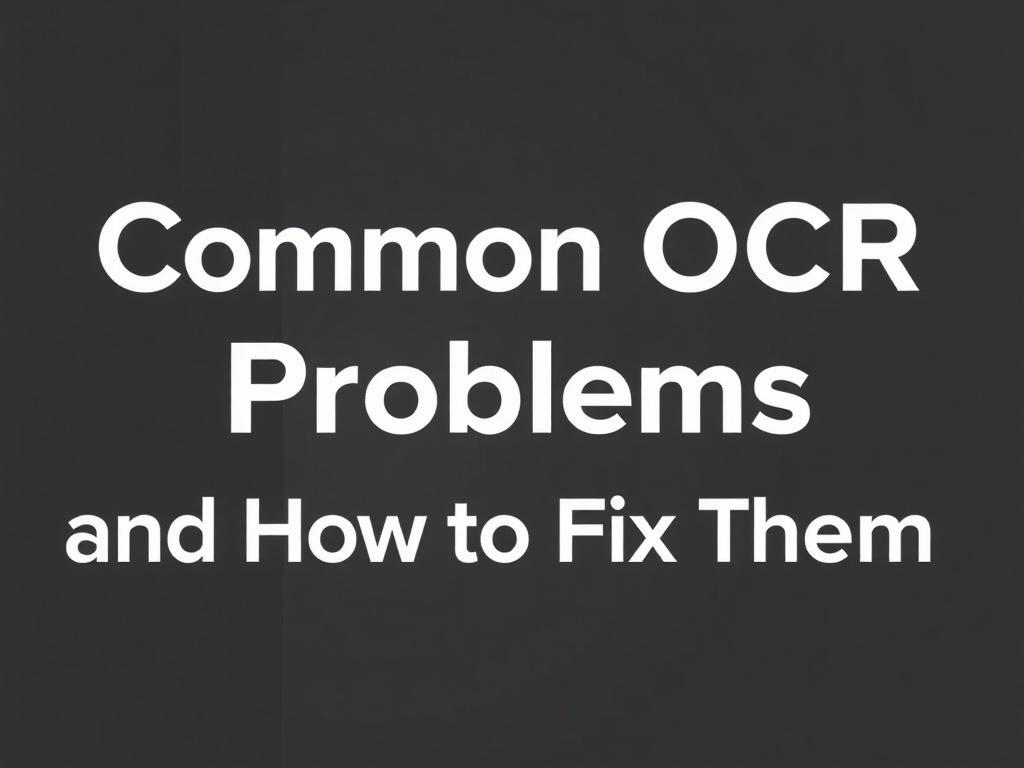
Optical character recognition can feel like a magic trick until it guesses your 8s are Bs and your totals don’t add up. The truth is, most misses aren’t mysterious; they’re predictable patterns you can address with a few practical steps. This guide walks through common OCR problems and how to fix them without tearing up your workflow. Consider it a field manual for making messy documents behave, not a sales pitch for a silver bullet.

Image quality: the root of most recognition errors

If your image is blurry, skewed, or crushed by compression, the engine is already fighting a losing battle. Aim for at least 300 dpi for text documents and 600 dpi for tiny fonts, stamps, or fine print. Prefer lossless formats such as TIFF or PNG when scanning; heavy JPEG compression introduces blocky artifacts that look a lot like stray characters. Before you click “recognize,” deskew, crop margins, and normalize contrast so letters look like letters again.

Preprocessing isn’t about fancy filters; it’s about clarity. Binarization (grayscale to black-and-white) with an adaptive threshold often lifts faint strokes without blowing out the page. A light despeckle and gentle sharpening clean up dust and soften halos from overexposed scans. If you’re dealing with phone photos, correct perspective and remove shadows first, or you’ll bake confusion into every page.

Symptom Likely cause Quick fix
1/l/I confusion Low resolution or poor contrast Scan at 300–600 dpi; boost contrast; sharpen lightly
Wavy baselines Skew or page curl Deskew; flatten book scans; crop tight
Random dots as commas Dust, speckles, JPEG artifacts Despeckle; use TIFF/PNG; clean glass
Broken letters Over-thresholding Use adaptive threshold; keep grayscale if needed

One easy win many teams miss: clean the scanner glass and rollers. Tiny smudges repeat across hundreds of pages and quietly poison results. If you rely on mobile capture, standardize lighting and distance, and use a capture app that enforces alignment. Quality in means quality out, with fewer downstream hacks.

Fonts, symbols, and the shape of trouble

OCR engines are good at everyday fonts and get shaky with exotic ones. Decorative faces, tightly tracked text, small caps, and italics raise error rates, as do ligatures like “fi” and “fl.” Documents full of math, chemical formulas, or music notation need specialized models; general-purpose engines guess and usually guess wrong. If you control the source, pick legible fonts and avoid micro-type where possible.

When you don’t control design, tune the engine to the text. Enable the correct language pack, limit the character set (whitelists/blacklists), and fine-tune recognition for expected symbols. For repeated tasks—say, shipping labels or part catalogs—train a custom model or add a domain lexicon so “P/N” and “kg” stop becoming “P/W” and “kg.” A little configuration beats hours of manual correction later.

Layout and reading order: when pages aren’t linear

Multi-column articles, sidebars, tables, and footers often scramble reading order. An engine might read straight across from left column to right, weaving headlines into body text like a bad braid. Complex forms add checkboxes, lines, and drop shadows that masquerade as characters. The more a page looks like a puzzle, the more you need layout detection.

Segment the page before recognition. Use zonal OCR for consistent regions (address blocks, invoice totals), and enable table detection where it exists. If you can export vector PDFs with a real text layer, do that instead of re-OCRing a flattened image. For book scans, flatten the curvature or use tools that dewarp pages so baselines run true.

Noise, stamps, and highlighters that hijack text

Real-world paperwork arrives with coffee stains, rubber stamps, and a rainbow of highlighter strokes. Those marks bleed into letters, merging shapes the engine can’t separate. Underlines cut through descenders and turn “g” into “q,” while blue pens look like faint text in grayscale. Left untreated, these artifacts create phantom words and phantom errors.

Color helps. Drop out highlight colors, subtract the red stamp channel, or scan in grayscale and run color-specific cleanup before binarization. Line-removal and morphology can erase ruling lines while preserving characters. I once processed a batch of annotated contracts, and the breakthrough was simple: isolate the yellow channel and tone it down 70 percent before thresholding; the OCR quality jumped from unusable to clean.

Language packs and dictionaries that don’t match

Running English recognition on a French memo guarantees strange output, especially around diacritics and common words. Even within English, a medical report full of Latin roots or a shipping manifest packed with SKUs can confuse a general dictionary. If your engine supports it, load the correct language and add custom vocabularies for names, products, and units. Context turns near-misses into perfect hits.

Post-processing is your safety net. Spellcheck with a domain dictionary corrects obvious slips, while pattern validators catch structured data. Think ZIP code formats, IBAN or routing numbers with checksums, dates constrained by locale, and totals verified by line-item sums. These guardrails turn OCR from “probably right” to “provably right.”

Automation and QA: measure, flag, and review

Most engines expose confidence scores by character, word, or zone. Use them. Route low-confidence fields to human review, and set thresholds per field—tighter for invoice totals, looser for notes. A small review queue beats silent errors in production.

Validation is your ally. Use regular expressions to confirm invoice numbers, require totals to equal the sum of lines plus tax, and reconcile names against a known customer list. Barcodes and QR codes can anchor a page and link it to expected metadata, reducing how much text you need to trust. When something doesn’t add up, fail fast and surface the issue.

Treat your pipeline like software. Version your OCR configurations, test on a representative sample set, and track accuracy over time. A/B test engines or settings on tricky documents, not just the easy ones. Small, measured tweaks—better thresholds, updated vocabularies—compound into big gains.

A lightweight checklist for reliable extraction

When projects get hairy, a simple checklist keeps teams from guessing. I keep one taped near the scanner and another in the repo next to the OCR config. It’s not glamorous, but it prevents the classic “why did accuracy drop this week?” fire drill.

  1. Scan at 300–600 dpi; prefer TIFF/PNG; clean the glass.
  2. Deskew, crop, and normalize contrast; fix perspective on phone shots.
  3. Choose the right language pack; add domain-specific vocabulary.
  4. Limit character sets; enable layout and table detection as needed.
  5. Handle color artifacts (stamps, highlights) before binarization.
  6. Validate structured fields with patterns and checksums.
  7. Use confidence thresholds and human review for critical fields.
  8. Measure accuracy on a standing test set; change one variable at a time.

The phrase you searched for—Common OCR Problems and How to Fix Them—sounds broad, but the fixes are concrete. Start with clean images, match your engine to your content, and put light-touch validation around the results. Do those three consistently and your error rate drops fast, your reviewers breathe easier, and the “magic trick” starts feeling like a dependable tool. That’s the goal: not perfection, just reliable text you can trust and reuse.

April 13, 2026 0 comment
0 FacebookTwitterPinterestEmail
Stop babysitting your scanner: practical OCR tricks that actually boost text extraction
OCR Technology

Stop babysitting your scanner: practical OCR tricks that actually boost text extraction

by Dylan Ramirez April 12, 2026
written by Dylan Ramirez

Good OCR isn’t magic; it’s a chain of small, sensible choices that add up. I learned this the hard way while digitizing a box of faded invoices—once I fixed how I scanned and prepped the images, accuracy jumped from “why is this gibberish” to “copy-paste and move on.” If you’re aiming for 12 OCR Tricks That Will Improve Text Extraction Results, start with the pages in your hands, then work forward to the engine and cleanup. The gains compound when you treat OCR like a workflow, not a button.

Start at the source: capture cleaner images

OCR struggles most with what the camera or scanner got wrong. Shoot for 300–400 DPI for standard text and higher (up to 600 DPI) for tiny print or degraded originals. Save to a lossless format like TIFF or PNG; JPEG compression adds artifacts that masquerade as letters.

Lighting and page shape matter as much as resolution. If you’re photographing, light evenly from two sides and flatten the page to kill shadows and curls. On flatbeds, wipe dust, disable “auto enhance” gimmicks, and use a black backing sheet to boost edge contrast on thin paper.

Document type Recommended DPI Color mode Notes
Printed contracts 300–400 Grayscale Turn off JPEG; enable text mode if available
Receipts 400–600 Grayscale Boost contrast; watch for thermal paper fade
ID cards 400–600 Color Preserve color for holograms and tiny fonts
Schematics 400 Binary or grayscale Keep thin lines crisp; avoid heavy denoise
Historical newspapers 400–600 Grayscale Plan for post-scan cleanup and dewarping

Preprocess like a photographer, not a programmer

Fix geometry before you touch pixels. Deskewing is table stakes; a 2–3 degree tilt is enough to tank word recognition. If you photographed a page, correct perspective and dewarp curves along the spine; otherwise the engine reads “wavy” text as broken strokes.

Then clean, but gently. Crop to content to remove borders, hole punches, and shadows that confuse layout detection. Convert to grayscale, use adaptive thresholding to binarize uneven pages, apply light denoising (median or bilateral) to kill speckles, and add just a touch of sharpening—overdo it and you create halos that look like serifs.

Tune the engine: settings that change results

OCR engines are surprisingly literal. Tell them the language(s) and install the right models so dictionaries and character shapes line up. If you’re reading part numbers or serials, turn off spelling corrections and constrain expected characters; the engine won’t “fix” a zero into the letter O if it’s not allowed.

Layout assumptions matter just as much. Choose a page segmentation mode that matches reality: single block of text, a receipt-like narrow column, or multi-column magazine pages. For complex forms, zone the page—define regions for headers, tables, and footers—so the engine reads in the right order and doesn’t mix totals with terms and conditions.

Postprocess and verify with intention

Even a great run leaves crumbs to sweep. Run a spellcheck against a domain dictionary to catch “the” vs “tbe” without rewriting part numbers. Regex is your friend for patterns like dates, ZIP codes, and invoice numbers; it can both validate and auto-correct common slips like l/1 and O/0 in the right contexts.

Use confidence scores to guide human time. Sort by lowest-confidence lines and sample a small percentage for review; you’ll spot systemic issues fast, like a font the model hates or a preprocessing step that’s too aggressive. Feed what you learn back into the pipeline so the next batch is cleaner by default.

The 12 practical tricks, at a glance

Here’s the short list I keep taped to my monitor when I’m building an OCR pipeline. It balances capture, cleanup, configuration, and quality checks so you’re not leaning on any one step to fix everything.

Pick the ones that match your bottleneck first, then layer on the rest. Small changes—like choosing the right segmentation mode or switching from JPEG to TIFF—often beat big, expensive leaps. If you measure accuracy before and after each tweak, you’ll build a stack that quietly delivers day after day.

  1. Scan at 300–400 DPI (600 for tiny text) and save to TIFF or PNG to avoid compression artifacts.
  2. Light evenly and flatten pages; kill shadows and page curl before you click “capture.”
  3. Deskew and dewarp early; correct perspective on camera images so lines of text are truly horizontal.
  4. Crop to content and remove borders, holes, and stamps that throw off layout analysis.
  5. Convert to grayscale, then use adaptive thresholding for clean binarization on uneven backgrounds.
  6. Apply gentle denoising (median/bilateral) and light unsharp masking to clarify strokes without halos.
  7. Normalize contrast and whiten the background; lift faint text from low-ink or faded scans.
  8. Specify the correct language(s) and install appropriate OCR models and dictionaries.
  9. Select a page segmentation mode that matches the layout (single block, column, or multi-column).
  10. Constrain expected characters with whitelists/blacklists or regex when reading codes and IDs.
  11. Zone complex pages into regions (headers, tables, footers) and use table-aware extraction when available.
  12. Postprocess with spellcheck and pattern fixes, then review low-confidence lines to catch edge cases.

When I migrated thousands of store receipts, steps 2, 5, and 9 did most of the heavy lifting; when I tackled dense legal PDFs, zoning and whitelists stole the show. Your mix will differ, but the workflow mindset is the same. Treat each document type as a tiny experiment, adjust, and lock in what works so the next run is calmer and faster than the last.

April 12, 2026 0 comment
0 FacebookTwitterPinterestEmail
Make your OCR stop guessing: practical ways to cut recognition mistakes
OCR Technology

Make your OCR stop guessing: practical ways to cut recognition mistakes

by Dylan Ramirez April 12, 2026
written by Dylan Ramirez

You don’t need a new algorithm to make your text extraction behave; you need better habits. This guide delivers OCR Accuracy Tips: How to Avoid Common Recognition Errors you can apply right now, without turning your workflow inside out. I’ll show you where accuracy usually falls apart, how to prevent it, and what to do when the odd character still slips through. Think of it as tuning the instrument before the performance.

Start with the page, not the software

The cleanest input wins. Scan at a true 300–400 dpi for standard text and 600 dpi for small print, footnotes, or serif-heavy books; phone photos can work, but only with steady lighting, no shadows, and a flat page. Shoot or scan in color when the background is textured or yellowed, then convert thoughtfully rather than forcing harsh black-and-white. Above all, keep the page square: deskew, crop margins, and correct perspective before the engine ever sees it.

Lossless beats lossy when you want crisp characters. Excessive JPEG compression introduces blocky halos that look like stray dots to your OCR, especially around punctuation and slender glyphs. When I digitize anything formal—forms, contracts, archival pages—I save master images as TIFF or PNG and only compress in downstream PDFs. If you must use a camera, stabilize it, avoid glass glare with cross-polarized lights or by angling the source, and dewarp book curves.

Scenario Recommended DPI Format Notes
Standard printed text 300–400 dpi TIFF/PNG Use color for aged paper, then convert
Small fonts, footnotes, newspapers 600 dpi TIFF/PNG Improves punctuation and diacritics
Phone capture 12MP+ (no zoom) JPEG (low compression) Even light, dewarp, and deskew

Tame layout and reading order

Most recognition “errors” are reading-order mistakes in disguise. Two-column articles, sidebars, footers, and tables confuse engines that expect a single stream of text. Use zoning: draw regions for columns, headings, and tables, or enable page segmentation modes that detect multiple columns. For tables, treat them as structured data—either grid-detect first or ask the engine to preserve cell boundaries.

Watch for headers and page numbers sneaking into paragraphs. Crop or classify them as non-body text before running OCR, or apply templates for recurring reports and forms. If you’re processing magazines or newspapers, pick an engine or mode optimized for complex layouts, and verify the output order by overlaying the recognized boxes on the image to spot jumps or overlaps.

Preprocessing that actually helps

Good binarization is oxygen for OCR. Global thresholds like Otsu can work on clean scans, but uneven lighting calls for adaptive methods (e.g., Sauvola or Wolf) to avoid washed-out letters. Denoise carefully: a light bilateral or median filter removes speckle without smearing thin strokes, and a gentle morphological opening can clear dust while preserving stems.

Forms benefit from color dropout: remove the preprinted blue or red lines so only handwriting and typed text remain. Normalize contrast with a mild gamma adjustment, then deskew and dewarp; engines do better with upright baselines and even line spacing. Finally, detect and fix inverted pages and rotated orientations before recognition—letting the OCR guess orientation costs accuracy and time.

Speak your OCR engine’s language

Pick the right language pack and dictionary, then disable the rest. If your page is in Spanish with a few English names, start with Spanish; if it’s code or serial numbers, consider numeric or alphanumeric whitelists. Many engines, including open-source ones like Tesseract, let you set page segmentation modes, character whitelists/blacklists, and hints for text orientation—use them to narrow the search space.

Fonts matter, too. Decorative scripts, small caps, and condensed sans-serifs challenge shape-based recognizers; increasing DPI and sharpening edges helps, but sometimes you need model training or a cloud service tuned for that font family. For historical prints with ligatures (ff, fi, fl), choose models trained on historical type or normalize those ligatures in post-processing to modern equivalents.

Catch the usual suspects: 0/O, 1/I/l and friends

OCR thrives on context; when context is thin, look-alike characters trade places. You can mitigate this by constraining the character set in numeric fields and by validating with patterns. For prose, dictionaries reduce nonsense words, while for IDs and codes, checksum rules and fixed lengths can flag a bad read instantly.

  • 0 vs O: Treat account numbers as digits-only; map “O” to “0” when surrounded by numerals.
  • 1 vs I vs l: In sans-serif text, favor “1” inside numbers, “I” in all-caps words, and “l” in mixed case using lexical checks.
  • 5 vs S, 2 vs Z: Correct based on neighbors and expected formats (e.g., SKU patterns).
  • , vs . and : Common in prices and times; normalize by locale and field type.

Post-processing with confidence

Don’t throw away confidence scores; use them to triage. Flag low-confidence words for review, or route pages below a threshold into a human-in-the-loop queue. Spell-check with domain dictionaries, and validate structured fields—emails, dates, and amounts—with regexes and range checks to catch subtle swaps.

For bulk jobs, sample smartly. Overlay recognized text on the source image and spot-check across different page types, poor scans, and dense tables. Keep a small feedback loop: corrections feed a custom dictionary, thresholds are adjusted, and preprocessing steps are tweaked where errors cluster.

A quick field story

While digitizing midcentury newsletters, my first pass looked passable until names and hyphenated line breaks unraveled the search index. The fix wasn’t exotic: I rescanned small-type pages at 600 dpi, switched to lossless masters, and enabled two-column segmentation. Hyphen handling plus a custom name list cleaned up the people index, and the engine finally stopped reading the masthead as part of the first paragraph.

On a batch of blue preprinted forms, camera captures kept misreading checkbox labels. Color dropout removed the blue grid, a mild dewarp flattened the page edges, and a numeric whitelist on ID fields eliminated letter look-alikes. With confidence-based review, only a sliver of fields needed a human glance, and the rest sailed straight into the database with clean audit trails.

April 12, 2026 0 comment
0 FacebookTwitterPinterestEmail
Stop fighting your scans: practical steps to clean, reliable OCR
OCR Technology

Stop fighting your scans: practical steps to clean, reliable OCR

by Dylan Ramirez April 11, 2026
written by Dylan Ramirez

Perfect-looking text from messy scans doesn’t happen by accident. It comes from a chain of small, sensible choices: how you capture the page, how you prepare it, which engine you pick, and what you do after recognition. If you’ve ever wrangled fuzzy PDFs at midnight, you know the pain—and the payoff when the words finally snap into focus. Here’s how to get there without drama, and yes, how to get perfect results with OCR technology in the real world.

Start with a clean image

OCR is only as good as the pixels you feed it. Aim for 300 dpi for standard documents and 400–600 dpi for tiny print, receipts, or intricate fonts. Scan to TIFF or PNG for lossless clarity; if you must use JPEG, keep compression light to avoid artifacts. Keep pages flat, high contrast, and free of shadows or folds.

Phone cameras work surprisingly well if you treat them like scanners. Shoot in bright, even light, fill the frame with the page, and align the edges to avoid perspective distortion. Turn off “beauty” filters and aggressive sharpening; they create halos that confuse character edges. For bound books, use a gentle weight or a cradle to reduce curvature near the spine.

  • Wipe glass and lens; dust looks like punctuation.
  • Use a dark backing sheet under thin paper to prevent bleed-through.
  • Capture in color when documents have stamps, highlights, or low contrast; switch to grayscale for plain, typed pages.

Recommended capture settings

Document type Resolution Color mode Format notes
Typed contracts, letters 300 dpi Grayscale TIFF/PNG for archiving; searchable PDF for sharing
Receipts, small print 400–600 dpi Grayscale or color Boost contrast; avoid JPEG compression
Magazines, colored stamps 300–400 dpi Color Preserve color to keep marks legible
Historical, fragile pages 400 dpi+ Color Gentle lighting; store a master image

Teach the machine what it’s looking at

Install the right language packs, including regional variants, before you hit “recognize.” Add custom dictionaries of names, product codes, or legal terms so the engine prefers “adjudicatory” over “adjutatory.” For Tesseract, whitelists/blacklists and user patterns steer recognition away from common mistakes like swapping 0/O or 1/l. Cloud services often accept hints about document type or expected fields—use them.

Structured pages reward a little prep. For invoices and forms, define zones by anchor text (“Invoice #,” “Total”) so the engine reads the right regions. If templates vary, set up a fallback: detect anchors first, then adjust zones relative to what you find. You’ll cut error rates more than any single “accuracy” toggle.

Preprocessing that actually helps

Skew correction is low-hanging fruit; even a few degrees off can make characters bleed into each other. Dewarp curved pages, remove noise speckles, and trim borders that trigger false page detections. Adaptive thresholding can rescue light gray text without blowing out fine serifs, but test it—overzealous binarization eats diacritics and punctuation.

Batch tools make this painless. OpenCV, ImageMagick, or built-in scanner software can deskew, denoise, and normalize contrast in one pass. Save your pipeline as a repeatable script so future batches match today’s quality. Consistency beats one-off perfection.

Layouts, tables, and forms without tears

OCR isn’t just characters; it’s structure. Pick an engine with layout analysis that understands columns, headers, footers, and reading order. For tables, enable table recognition and export structured results, not just text blobs—ALTO XML, hOCR, or JSON preserve cell boundaries you’ll need later. When engines misread lines, post-process with simple rules: merge rows split by soft line breaks; validate numeric columns by totals.

Forms benefit from field definitions. Tell the system a date looks like MM/DD/YYYY or that an invoice total must equal the sum of line items and tax. These guardrails catch recognition errors early and keep bad data from slipping downstream.

Post-processing that catches the last 5%

Spellcheck with a domain lexicon is a quiet hero. In a medical archive, adding “metoprolol,” “gabapentin,” and company slashes absurd substitutions. Use regex for emails, phone numbers, SKUs, and IDs; anything that breaks the pattern flags a review. Cross-field checks—like matching vendor names against a master list—clean up the rest.

Measure what matters. Track character error rate (CER) or word error rate (WER) on a labeled sample, and keep a small gold set for regression tests. If accuracy drifts after a scanner change or a settings tweak, you’ll spot it fast. A human-in-the-loop pass on low-confidence pages pays for itself.

Choosing the right engine for the job

Tesseract is fast, open-source, and flexible, especially with good preprocessing and custom dictionaries. ABBYY FineReader is strong on complex layouts and multi-language documents. Google Cloud Vision, Microsoft Read, and Amazon Textract scale well, add handwriting support, and return structured outputs—but weigh data privacy and cost.

For handwriting, look for ICR models, not just classic OCR. Results vary wildly by writer and pen contrast; sample before you commit. Sometimes the best path is hybrid: a cloud engine for forms and handwriting, Tesseract for clean printed text on-prem.

Build a repeatable workflow

Give every batch a home: consistent file names, a place for originals, and a place for processed outputs. Export two things when you can: a searchable PDF for humans and a structured file (CSV, JSON, or XML) for systems. Log versions of your pipeline and engine so a clean rerun is always possible.

Schedule jobs, not emergencies. Automate folder watches, queue processing, and confidence-based review buckets. When something fails, keep the inputs and the logs; nothing is more valuable than being able to reproduce a bug with one command.

A quick field story

On a rush project, a client sent me phone photos of crumpled, low-ink receipts and wanted totals by morning. The first pass was a mess—zeros became O’s, tips merged into totals. We reshot on a desk under a lamp, 400 dpi with a scanning app, and ran a short pipeline: deskew, denoise, adaptive threshold, then OCR with a small dictionary of store names and a “currency” regex. Accuracy jumped from barely usable to comfortably above 98% WER on a sample, and the reconciliation step found the last strays.

Bringing it together

There’s no single magic button. Great OCR is a stack: clean capture, sensible preprocessing, tuned engines, and smart validation. Do that well, and the words fall into place—and you’ll be as close as it gets to how to get perfect results with OCR technology without relying on luck. The best part is repeatability: once you’ve built the path, every new batch walks it on its own.

April 11, 2026 0 comment
0 FacebookTwitterPinterestEmail
Smart OCR systems that can understand documents
OCR Technology

Smart OCR systems that can understand documents

by Dylan Ramirez April 2, 2026
written by Dylan Ramirez

Optical character recognition has evolved from simple text extraction into a capability that reads, reasons, and integrates information from complex documents. Modern systems combine image processing, machine learning, and language understanding to do more than spit out raw characters — they interpret tables, headers, and relationships. This article walks through the technologies, uses, and trade-offs of intelligent OCR that approaches human-like document comprehension.

What makes an OCR system “smart”?

A traditional OCR engine converts pixels to text, often producing a plain transcription that requires manual cleanup. A smart system layers structure on top of text: it recognizes forms, zones, relationships, and intent, turning unstructured scans into structured data you can query and act on. That additional layer is what enables automation of workflows that previously demanded human review.

Smart systems also adapt. They learn from corrections, generalize across document templates, and use language context to resolve ambiguous characters or formatting. This adaptivity reduces error rates in messy inputs — photographed receipts, low-contrast invoices, or handwritten notes — and improves over time without constant rule-writing.

Core technologies that enable understanding

At the foundation are image-enhancement and text-recognition models that handle noise, skew, and distortions. Preprocessing steps like dewarping and denoising make characters legible; segmentation identifies blocks such as paragraphs, tables, and footers. Those steps create a clean, structured representation ready for higher-level analysis.

On top of that, machine learning models ingest the structured output to perform layout analysis, named-entity recognition, and relation extraction. These models assign semantic roles — for example, identifying vendor names, invoice totals, or effective dates — enabling downstream systems to map fields into databases and trigger business logic automatically.

How language models and context help

Language models bring contextual understanding that pure image models cannot provide. They use surrounding words and common document patterns to disambiguate OCR errors: an early character that looks like a “5” might actually be an “S” if it fits a name or keyword. Contextual models also infer missing or implied fields, such as recognizing that a string labeled “Due” followed by a date likely represents a payment deadline.

These models also support semantic parsing, which translates human phrasing into structured concepts. For example, a statement like “payment within 30 days” can be converted into explicit terms and deadlines that accounting software can act upon. The result is not just text but actionable meaning.

Practical applications and benefits

Organizations use intelligent OCR to automate invoice processing, extract patient information from medical forms, and ingest legal contracts into searchable repositories. By capturing structure and semantics, these systems reduce manual entry, speed processing times, and lower error rates in repetitive tasks. The payoff is both operational efficiency and improved data quality across business processes.

Beyond cost savings, smart document understanding unlocks analytics. Once documents are normalized into fields and relationships, organizations can query trends, enforce compliance, and surface anomalies automatically. That visibility is especially valuable in regulated industries where traceability and auditability matter.

Challenges and limitations

No system is perfect. Variability in layouts, handwriting styles, foreign languages, and image quality still cause mistakes that require human oversight. Domain-specific jargon and unusual document designs can confuse models trained on general corpora, producing misclassifications that propagate into downstream systems if unchecked.

Privacy and data security also complicate deployment. Documents often contain sensitive personal or financial information, so organizations must design secure ingestion pipelines and robust access controls. In many cases, a hybrid approach that routes uncertain cases to human reviewers strikes the right balance between automation and risk mitigation.

Best practices for deploying smart OCR

Successful deployments start with clear objectives and a well-defined scope. Identify the document types and fields that deliver immediate value, instrument systems to capture correction feedback, and iterate your models rather than attempting a big-bang conversion of every format at once. Small, measurable wins build confidence and accumulate training data.

Operationally, build a feedback loop that includes human validation, continuous retraining, and monitoring of key metrics like field-level accuracy and processing time. Below is a simple checklist to guide initial rollouts.

Consideration Why it matters
Start with high-volume templates Maximizes ROI and provides ample training data
Implement human-in-the-loop Reduces errors and collects corrective labels
Secure data in transit and at rest Protects sensitive information and meets compliance

Real-world examples and author perspective

In one project I worked on, a mid-sized insurer used document understanding to process claims forms received by fax. Initially, the OCR accuracy on handwritten notes was poor, but integrating a handwriting model and routing low-confidence fields to human reviewers reduced the manual workload by 60 percent within three months. The team measured outcomes weekly and retrained models with corrected labels, which steadily improved recall for critical fields.

Another client automated contract ingestion into a searchable knowledge base, using semantic parsers to tag clauses and obligations. Legal staff regained hundreds of hours previously spent on manual indexing, and the organization gained the ability to run enterprise-wide queries for specific clauses — a capability that transformed compliance reviews.

Looking ahead: where document understanding is going

Future progress will blur the line between reading and reasoning. Multimodal models that jointly process images and text will better handle diagrams, forms, and mixed-language content. Expect more off-the-shelf tools that require less customization while providing explainable outputs suitable for regulated environments.

For practitioners, the practical advice remains the same: prioritize high-impact workflows, instrument feedback loops, and treat document understanding as an evolving capability rather than a one-time project. When systems are designed to learn from their mistakes and integrated into human workflows, they stop being brittle tools and start becoming reliable partners in knowledge work.

April 2, 2026 0 comment
0 FacebookTwitterPinterestEmail
The future of OCR technology: how machines learn to read
OCR Technology

The future of OCR technology: how machines learn to read

by Dylan Ramirez April 1, 2026
written by Dylan Ramirez

Optical character recognition has quietly evolved from a niche scanner trick into a foundation for automated knowledge work. Early systems matched shapes to characters; today’s pipelines combine vision, language, and workflow logic to interpret documents the way a human would. This article explores how AI and automation drive that shift, what practical gains look like, and where organizations should focus next.

From pattern matching to context-aware recognition

Traditional OCR treated text as isolated glyphs, optimized for clean type and predictable layouts. It struggled with complex forms, handwritten notes, and mixed-language documents. Modern approaches embed recognition in a larger understanding of structure and meaning, so extracted text becomes usable data instead of noisy output.

That change matters because most business documents aren’t neat lines of type. Invoices, contracts, and medical records include tables, stamps, signatures, and annotations that require contextual interpretation. AI lets OCR systems reconcile layout, semantics, and even intent—picking the right field value when multiple candidates exist.

AI advancements reshaping OCR

Three developments have driven recent progress: deep learning for visual recognition, language models for interpretation, and architectures that combine both. Each area reduces brittle rule sets and improves generalization across fonts, languages, and document conditions. The result is more accurate, faster deployments and less manual correction.

Another practical effect is reduced pre-processing. Instead of heavy image cleanup, pipelines can accept phone photos, scans, and screenshots and still produce reliable outputs. That flexibility opens OCR to frontline workflows where controlled capture environments aren’t available.

Deep learning and neural networks

Convolutional neural networks and sequence models replaced handcrafted feature detectors, learning representations from millions of character instances. These networks recognize typefaces, distortions, and noisy backgrounds that used to break legacy engines. They also enable handwriting recognition that approaches human-level performance for many scripts.

Training remains data-hungry, so synthetic augmentation and transfer learning are common strategies. By fine-tuning models on a narrow set of example documents, teams can reach production-quality accuracy without collecting prohibitively large datasets.

Transformers and attention mechanisms

Transformers introduced attention, which helps systems weigh context when decoding text from an image. In OCR this means models don’t just predict characters sequentially; they consider surrounding words, layout cues, and even nearby graphics. That capability improves accuracy on multi-column pages, tables, and documents with embedded metadata.

Multimodal transformers—models that jointly process images and text—are particularly useful for tasks like key-value pair extraction and document classification. They bridge the gap between raw pixel recognition and semantic understanding, enabling richer downstream automation.

Automation and workflow integration

OCR is rarely an end in itself; it’s the entry point for automation—robotic process automation, back-office processing, or real-time decisioning. Integrating OCR with business rules, validation services, and human-in-the-loop review turns recognized text into trusted data. That pipeline thinking is where ROI becomes measurable.

Companies are also adopting continuous learning loops: uncertain extractions get reviewed by humans, those corrections retrain models, and the system improves over time. This active learning approach dramatically reduces long-term error rates while keeping intervention minimal.

Feature Legacy OCR AI-driven OCR
Accuracy on messy inputs Low High
Handwriting recognition Poor Good to excellent
Layout understanding Limited Strong
Adaptability Rule-based Data-driven

Real-world applications and examples

Finance, healthcare, logistics, and government are all heavy users of modern OCR. Invoice processing pipelines extract line items and totals, reducing manual data entry; claims systems pull diagnosis codes and notes to speed adjudication; and customs operations digitize shipping manifests for faster clearance. The common thread is turning documents into structured triggers for downstream systems.

In a recent project at a mid-sized bank, I helped build an OCR pipeline that processed mortgage documents. By combining an image-first model with rule-based validation and a quick human review step, the team cut processing time from days to hours and reduced error rates enough to redeploy staff to higher-value tasks.

  • Accounts payable automation
  • Patient record digitization and coding
  • Identity verification and KYC
  • Legal discovery and contract analytics

Challenges: accuracy, ethics, and privacy

Despite advances, OCR still faces hard problems. Poor lighting, extreme handwriting, unusual fonts, and heavily formatted documents can confound models. Evaluation requires realistic test sets and continuous monitoring—accuracy numbers from lab tests can be misleading in production environments.

Ethical and privacy concerns are also paramount. Extracting personal data demands secure handling, compliance with regulations like HIPAA or GDPR, and careful decisions about on-device versus cloud processing. Explainability matters: teams need to trace why a value was extracted to trust automation in regulated contexts.

What organizations should do next

Start with a focused pilot: pick a high-volume, rule-bound document type and instrument the process to measure error rates and cycle time. Use synthetic data and transfer learning to kickstart model performance, and build a human-in-the-loop review for edge cases. Those steps lower risk and surface integration challenges early.

Invest in monitoring and retraining pipelines so models evolve with changing document sources. Finally, prioritize data governance: secure capture, explicit consent where required, and a clear audit trail will keep systems both effective and compliant.

OCR has grown from a simple recognition tool into an intelligence layer that connects paper and pixels to automated decisions. With care—good data, thoughtful integration, and attention to ethics—organizations can unlock substantial efficiency while preparing for the next wave of AI-driven understanding. The machines are learning to read; now it’s our job to teach them to act wisely on what they see.

April 1, 2026 0 comment
0 FacebookTwitterPinterestEmail
How deep learning is making OCR more accurate than ever
OCR Technology

How deep learning is making OCR more accurate than ever

by Dylan Ramirez March 31, 2026
written by Dylan Ramirez

Optical character recognition used to feel like a mechanical trick: scan a page, match shapes to letters, hope for the best. Over the past decade, a quiet revolution has replaced brittle heuristics with models that learn from millions of examples, and the effect on real-world accuracy has been profound. This article looks under the hood at what changed, why those changes matter, and how organizations are putting better OCR to work.

From rule-based systems to learning from data

Early OCR systems relied on handcrafted features and rule sets tuned for specific fonts and clean scans. They struggled when text shifted, fonts varied, or pages were degraded—conditions common in historical archives, receipts, and photos. Those limitations forced enormous manual correction and constrained automation to narrow, controlled domains.

Deep learning altered the equation by letting models discover the relevant features directly from data. Instead of coding rules for every special case, engineers feed diverse examples—different fonts, lighting, skew, and noise—and the model learns robust patterns. That shift from rules to data is the foundation of the accuracy gains we see today.

Neural building blocks that changed the game

Convolutional neural networks (CNNs) brought reliable visual feature extraction, making recognition tolerant to small distortions and variations in stroke thickness. Recurrent neural networks and long short-term memory units (LSTMs) helped models interpret sequences of characters, capturing context that separates ambiguous shapes—think distinguishing an ‘l’ from a ‘1’ based on surrounding letters.

Connectionist Temporal Classification (CTC) and attention mechanisms removed the need for perfectly segmented characters, enabling end-to-end recognition from whole lines or blocks of text. More recently, Transformer architectures—originally developed for language—have been adapted for image-to-text tasks, improving long-range dependency modeling across lines and columns. These components combine to make predictions that feel less like independent guesses and more like fluent reading.

Practical OCR systems typically pair a text detector with a recognizer: the detector finds lines or words, and the recognizer reads them. Both stages benefit from deep models; detectors handle complex layouts, while recognizers resolve ambiguous glyphs using learned priors. That modular design balances accuracy and efficiency in production.

Real-world gains and tangible examples

Improvements are not only academic. Open-source engines that adopted neural networks, such as Tesseract’s LSTM-based update, showed measurable improvements across a broad set of languages and document qualities. Enterprises that replaced legacy pipelines with deep-learning solutions often report fewer manual corrections and faster throughput when processing invoices, IDs, or forms.

In my experience working with a nonprofit digitizing local newspapers, switching the pipeline to a neural-based recognizer drastically reduced error-driven review. Pages that previously required line-by-line correction could be processed with targeted spot checks instead. That change translated into completed projects months earlier and lower hourly costs for volunteers.

Approach Strengths Weaknesses
Traditional OCR Fast on clean, predictable inputs; low compute Fails on noise, varied fonts, and complex layouts
Deep learning OCR Robust to variation; handles handwriting and images Requires labeled data and more compute to train

Handling messy inputs: handwriting, photos, and complex layouts

Deep models shine where traditional systems stumble: handwritten notes, angled smartphone photos, and multi-column newspapers. Data augmentation—artificially simulating blur, rotation, and stains—teaches models to tolerate the kinds of degradation found in the field. Synthetic data generation supplements scarce labeled examples, especially for rare scripts or stylized fonts.

For handwriting recognition, combining visual encoders with sequence models captures the flow of pen strokes without requiring perfect segmentation. For photographed documents, preprocessing networks estimate geometric correction and lighting adjustments as part of the pipeline, reducing the need for separate manual cleanup steps. These integrated approaches reduce end-to-end error rates on messy inputs.

  • Data augmentation to simulate real-world noise
  • Synthetic data for low-resource languages or fonts
  • Detector-plus-recognizer architectures for complex pages
  • Language models for contextual correction and formatting

Deployment realities: speed, cost, and hybrid systems

Higher accuracy often comes with greater computational cost, so production systems balance model size, latency, and cloud versus edge deployment. Lightweight neural models and quantization techniques let OCR run on phones and scanners, while larger models process batch document archives in the cloud. The choice depends on throughput needs and privacy constraints.

Many organizations adopt hybrid workflows: use a lightweight model to process the bulk of documents and flag uncertain lines for a heavier model or human review. This staged approach achieves high overall accuracy without sending everything through expensive compute. Monitoring error patterns also reveals where additional training data will yield the biggest gains.

What’s next for OCR accuracy

Expect continued gains as models incorporate more context—full-page understanding, cross-page consistency, and layout semantics. Multimodal models that jointly reason about images and text will improve format-aware extraction, such as correctly associating table headers with columns or recognizing nested fields in complex forms. Those capabilities will reduce downstream manual labor and unlock automation for more document types.

The tide of deep learning has turned OCR from a brittle tool into a flexible reader. For anyone managing scans, receipts, or historical archives, the practical consequence is simple: fewer surprises, faster workflows, and more reliable data. The technology still requires care—good data, sensible pipelines, and ongoing monitoring—but its trajectory is clear: machines are getting markedly better at reading the messy, human world.

March 31, 2026 0 comment
0 FacebookTwitterPinterestEmail
Understanding OCR: how AI changes the game
OCR Technology

Understanding OCR: how AI changes the game

by Dylan Ramirez March 30, 2026
written by Dylan Ramirez

Optical character recognition is no longer a single, predictable technology you can box into one definition. When people compare modern systems, they often frame the discussion as AI OCR vs Traditional OCR: Key Differences Explained to highlight how learning-driven models differ from rule-based engines. This article walks through the technical contrast, real-world implications, and decision points for choosing one approach over the other.

What traditional OCR looks like

Traditional OCR systems rely on deterministic rules and pattern matching to turn pixels into characters. They work best on clean, high-contrast documents with predictable fonts and layouts, using character templates, heuristics, and language dictionaries to correct errors.

These engines are efficient for structured inputs like scanned forms, printed books, and invoices where variability is low or controllable. Because their behavior is predictable, they are easy to validate and certify in regulated environments, but they struggle with handwriting, noisy photos, and unusual fonts.

What AI-powered OCR brings to the table

AI OCR uses machine learning—usually deep neural networks—to learn character shapes, context, and document structure from data rather than hard-coded rules. Modern models combine convolutional layers for visual feature extraction with sequence models or attention mechanisms to interpret lines of text and infer missing or ambiguous information.

This makes AI OCR more tolerant of poor lighting, skewed scans, mixed fonts, and handwritten notes. It also allows systems to generalize from examples, adapt to new document types, and improve over time with additional labeled data or weak supervision.

Core technical differences

At a high level, the divide is one of rules versus learned representations: traditional OCR matches patterns defined by humans, while AI OCR builds internal representations from training data. Traditional systems apply deterministic post-processing like dictionary corrections and fixed layout rules, whereas AI pipelines often integrate language models to provide probabilistic corrections and context-aware interpretation.

These architectural differences influence deployment: traditional OCR can run on lightweight hardware with predictable memory and CPU needs, while AI OCR benefits from acceleration (GPUs or specialized inference chips) and more complex software stacks to manage models and updates.

Quick comparison table

Aspect Traditional OCR AI OCR
Best fit Clean, consistent documents Variable, noisy, and handwritten documents
Adaptability Low — needs manual rules High — improves with data
Hardware Lightweight Often requires accel.
Maintenance Rule tuning Data and model retraining

Accuracy, adaptability, and speed

Accuracy differs by context: on high-quality printed text both approaches can be very good, but AI OCR typically wins on messy, variable inputs. AI models use context from surrounding words and document structure to reduce character-level errors and to fill in gaps caused by noise or occlusion.

Speed trade-offs are real: optimized traditional engines may process documents faster on a CPU, while AI systems can be faster at scale if deployed with efficient inference stacks and batching. The right balance depends on throughput requirements, available hardware, and the acceptable error rate for downstream tasks.

When to choose which: practical use cases

If your workload consists mainly of standardized forms, archived print, or tightly controlled scans, traditional OCR is a sensible, cost-effective choice. It is straightforward to validate and often integrates smoothly with legacy workflows that expect deterministic outputs.

Choose AI OCR when documents vary in layout, include handwriting, or arrive as photographs from mobile devices. Industries like insurance claims, healthcare intake, and logistics benefit from AI’s tolerance for variability and its ability to extract structured data from complex layouts.

  • Traditional OCR: mass digitization of printed books, fixed-template invoices.
  • AI OCR: mobile receipts, handwritten notes, multi-language documents.

Implementation and cost considerations

Upfront costs for traditional OCR are generally lower because the software footprint and compute needs are modest. Maintenance focuses on rule updates and occasional template additions, which can be handled by in-house teams without machine learning expertise.

AI OCR usually requires investment in labeled data, model lifecycle tools, and monitoring to manage drift and bias. However, those costs can pay back through reduced manual review, more reliable extraction across diverse inputs, and faster onboarding for new document types.

My experience deploying OCR in production

In a recent project I helped automate an accounts-payable pipeline that originally used a template-based engine with extensive manual corrections. Switching to a modern AI OCR reduced downstream validation tasks by about 60 percent, especially for supplier invoices submitted as photos from mobile phones.

The transition required building a small labeled dataset and adding model monitoring to catch edge cases, but the team regained that cost within months through reduced manual labor and faster vendor payments. The practical lesson was simple: invest in data and validation to unlock the best value from AI OCR.

Choosing between traditional OCR and AI-driven systems comes down to document variability, scale, and the tolerance for manual oversight. Traditional engines remain useful for certain predictable, low-variability tasks, while AI OCR opens new possibilities for extracting value from messy, real-world documents.

March 30, 2026 0 comment
0 FacebookTwitterPinterestEmail
Find the best OCR apps for Android and iPhone in 2026
OCR Technology

Find the best OCR apps for Android and iPhone in 2026

by Dylan Ramirez March 15, 2026
written by Dylan Ramirez

Smartphone cameras are finally doing the heavy lifting for paperwork, receipts, and handwritten notes, and OCR apps have grown both sharper and friendlier. This guide highlights the Best OCR Apps for Android and iPhone in 2026 and explains which ones make sense depending on how you scan. I tested these tools on a mix of printed pages, receipts, and messy handwriting to see what really works in everyday use. Below you’ll find strengths, limits, and practical tips to get clean, editable text from your phone.

Why mobile OCR still matters in 2026

Paper clutter hasn’t disappeared, but the ways we handle it have changed dramatically, and OCR sits at the center of that change. Modern apps do more than convert images into text; they extract data, translate languages, and feed documents into cloud workflows. That means you can capture a contract at a café, pull client names from receipts, or translate a menu in real time without ever touching a desktop scanner. The combination of faster processors and smarter models has made mobile OCR reliable enough for serious work.

Beyond convenience, OCR frees information trapped in analog formats and makes it searchable and editable, which is a real productivity multiplier. Privacy and speed have also improved, with many apps offering on-device processing so sensitive text never leaves your phone. Still, OCR performance varies a lot depending on the lighting, font, or a hurried handwriting sample. Choosing the right app is about matching features to your most common scanning jobs.

How I evaluated these apps

To keep testing consistent, I scanned the same set of documents on both Android and iPhone devices: a printed contract, a receipt, a typed menu photographed at an angle, and a page of mixed handwriting. I judged accuracy, layout retention, handwriting recognition, language support, and export options such as PDF, Word, and cloud services. Battery impact, offline capability, and how intuitive the UI felt were also part of the checklist. I prioritized real-world reliability: does the app save me time and steps when I actually need it?

Where possible, I used both free and premium tiers so recommendations reflect what most users will encounter before signing up. I also paid attention to privacy policies and whether OCR could be run locally, because that matters for business documents and personal records. When a feature claimed automatic table detection or handwriting-to-text, I verified it with multiple samples to avoid overstating capabilities. The short version: I preferred apps that returned accurate text with minimal manual correction and made exporting painless.

Top picks for everyday scanning

Below are five apps that stood out in testing. Each has strengths that suit different users—students, small business owners, travelers, or anyone trying to tame paper. I focus on what each app does best and where it may fall short so you can pick based on workflow rather than hype. After the summaries, there’s a quick comparison table and a few practical tips.

These picks reflect current capabilities: fast on-device recognition, good handwriting handling, and flexible export options. Expect frequent updates through 2026, especially around AI-driven layout preservation and multilingual OCR. If you rely on a specific cloud ecosystem, that will often be the tie-breaker when two apps perform similarly. Now, the individual apps.

Google Lens

Google Lens is a go-to for quick, accurate text capture and instant actions like translation, copy-and-paste, and phone-number dialing. Its strengths are speed, seamless integration with Android and iOS, and excellent multilingual OCR powered by Google’s models. It’s ideal for travelers or anyone who needs immediate text extraction and translation without importing files into another app. The downside is that it’s focused on quick interactions rather than heavy-duty document workflows or batch exports to PDF.

In my testing, Lens handled skewed menus and multi-column layouts better than many competitors in the same instant-capture scenario. It also performs well with printed text in low light thanks to smart exposure adjustments. If you need organization and long-term document management, pair Lens with a dedicated scanner app or cloud folder. For spontaneous capture and translation, it’s hard to beat.

Microsoft Lens

Microsoft Lens excels when you want scans that integrate directly with Office, OneDrive, or Teams, and its OCR accuracy for printed documents is solid. It produces clean Word and PowerPoint exports and preserves basic layout, which makes it a practical choice for students and office workers. The app also supports whiteboard capture with perspective correction, which is helpful after meetings or lectures. For handwriting, results vary, but printed text is reliably converted into editable files.

One practical plus is the tight link to Microsoft 365: scans drop into your cloud and are searchable via OneDrive quickly. If your workflow lives in Microsoft’s ecosystem, Lens saves time by eliminating import-export steps. Where it lags is in advanced image cleanup and fine-grained OCR settings that power users sometimes want. Still, for seamless Office integration it’s one of the best options available.

Adobe Scan

Adobe Scan focuses on document fidelity and PDF workflows, with strong OCR that preserves formatting and converts scans into editable PDFs. The app is great for receipts, contracts, and multi-page documents, and it offers automatic edge detection and cleanup. Integration with Adobe Acrobat and cloud storage makes it easy to annotate, sign, or combine documents. The free tier is generous, but advanced export and productivity features are part of the paid Acrobat ecosystem.

In practice I found Adobe Scan especially handy when I needed a final PDF-ready output that would be shared or archived. It handles light balancing and de-skewing well, producing professional-looking scans straight from the phone. If you frequently create PDFs for clients or legal records, the workflow is smooth and dependable. Casual users who don’t need Acrobat integration might prefer a lighter app, though.

ABBYY FineReader PDF (mobile)

ABBYY has long been synonymous with high-accuracy OCR, and the mobile FineReader app continues that tradition with excellent recognition and layout retention. It supports many languages and does particularly well with complex layouts and table extraction. For professionals who need near-desktop-level OCR on a phone, ABBYY is a strong choice and offers batch processing and export to multiple formats. The trade-off is a costlier subscription compared to general-purpose scanner apps.

During testing, FineReader outperformed others on typed documents with unusual fonts and on PDFs that needed text layer regeneration. Its table detection was more reliable than most competitors, which saved time when pulling invoice data. If you need precision and robust language support, it’s worth the investment. For casual scanning, however, the features may be overkill.

Prizmo

Prizmo stands out on iPhone for its combination of ease-of-use, solid OCR, and unique features like voice reading and adjustable recognition zones. It’s especially useful for users who want accessibility features and clear text export without a steep learning curve. The app handles photos of books and magazines well and offers localization for several languages. While it’s more iOS-centric, its accuracy on both printed text and decent handwriting is noteworthy.

I used Prizmo when scanning mixed-layout pages and appreciated the quick corrections and export options. The voice readback helped confirm recognition accuracy without jumping into a document editor. If you want a pleasant, accessible scanning experience on iPhone, Prizmo is a compelling pick. Android users will need to look at equivalent options, but the app sets a good standard for usability.

App Best for Free tier
Google Lens Instant capture & translation Yes
Microsoft Lens Office workflows Yes
Adobe Scan PDF creation and archiving Yes
ABBYY FineReader High-accuracy OCR & tables Limited
Prizmo Accessible, polished iOS scanning Limited

Tips for getting better scans

Good results start with good input: steady hands, even lighting, and avoiding glare will improve OCR accuracy dramatically. Use the app’s guide or grid to align pages, and try both color and grayscale captures to see which yields cleaner text. For handwriting, capture at close range and take multiple shots if necessary, then choose the clearest image for OCR. If privacy matters, enable on-device processing or check the app’s export settings before uploading any sensitive documents.

Batch scanning saves time when you have many pages, but check a single page first to confirm recognition settings. When extracting structured data like invoice totals, export to CSV or copy into a spreadsheet to validate fields quickly. Keep your phone’s software and the app updated, as OCR models and camera APIs improve with each release. Finally, build a small archive system — tag or folder your scans so they’re searchable long-term.

Putting it into practice

For most people, a combination works best: use Google Lens for quick captures and translation, a dedicated scanner app like Adobe Scan for PDFs, and ABBYY when precision matters. I still keep two apps on my phone and switch depending on whether I’m on the go, at my desk, or processing receipts after a trip. Try one of the free options first, then pay for a subscription only if it noticeably cuts editing time. With the right app and a few simple habits, your phone becomes a reliable scanner and text extraction tool for daily life.

March 15, 2026 0 comment
0 FacebookTwitterPinterestEmail
Turn piles of paper into useful data: OCR tools that do the heavy lifting
OCR Technology

Turn piles of paper into useful data: OCR tools that do the heavy lifting

by Dylan Ramirez March 15, 2026
written by Dylan Ramirez

Optical character recognition has stopped being a niche trick and become the backbone of modern document workflows. Whether you run a boutique accounting firm or manage invoices for a multinational, the right OCR solution will extract text, classify documents, and hand clean data to your downstream systems. This article walks through why OCR matters now, how to choose the best option, and a practical look at a dozen tools worth evaluating.

Why OCR matters today

Paper still exists, but business decisions run on data. OCR converts scanned pages, receipts, and PDFs into searchable text and structured fields so that finance, legal, and operations teams can automate routine work. Beyond simple transcription, modern OCR layers layout analysis, language models, and field extraction to handle messy real-world documents.

Faster data capture reduces human error, lowers processing cost, and shortens cycle times for invoices, claims, and compliance checks. It also unlocks analytics: once documents are machine-readable, you can aggregate data across thousands of records and spot trends you would never see by manual review. The right solution fits your scale, privacy needs, and legacy systems.

How to choose the right OCR tool

Start with the outcomes you need: do you want raw text, key-value pairs, table extraction, or complete end-to-end automation? Accuracy on your document types is the most important metric, so run a small pilot with representative samples. Also weigh integrations — an API-first product saves development time while packaged desktop tools may suit single-user workflows.

Consider language support, handwriting recognition, and on-premises options if you have strict security requirements. Cost structure matters: some products charge per page, others by API calls or seats. Finally, test the post-processing features like confidence scores and correction workflows, because human-in-the-loop tools often deliver the best ROI for borderline cases.

12 powerful OCR tools that automate document processing

ABBYY FineReader combines traditional OCR accuracy with document conversion and layout preservation. It’s strong on structured documents and supports many languages, with desktop and SDK options for embedding into larger systems. In my firm’s contract intake pilot, ABBYY reduced manual proofreading by more than half thanks to its table and form recognition. It’s best for organizations that need high-fidelity conversion and a mature vendor ecosystem.

Google Cloud Vision OCR is an API-first option that excels at scale and language coverage. It integrates easily with Google Cloud storage and analytics, and its handwriting recognition is continually improving thanks to Google’s ML stack. I’ve seen teams route scanned receipts through Vision OCR into an expense automation pipeline with straightforward JSON outputs. Expect usage-based pricing and strong support for unstructured images.

Microsoft Azure Computer Vision offers robust OCR alongside other cognitive services like layout extraction and language understanding. It fits well when you already use Azure services and want seamless identity and storage integration. Companies processing mixed documents benefit from Azure’s table recognition and enterprise SLAs. Security-conscious customers can combine it with Azure private network features.

Amazon Textract is designed to pull structured data — forms and tables — not just raw text. Textract’s strength is automating workflows where you need key-value pairs and cell-level table extraction for invoices or tax forms. In a proof-of-concept I observed, Textract dramatically reduced downstream reconciliation time by reliably extracting line items. It pairs well with AWS analytics and workflow tools for end-to-end automation.

Tesseract is the most widely used open-source OCR engine and a sensible choice if you want zero licensing cost and full control. It’s highly extensible and works well with pre-processing libraries like OpenCV. I’ve used Tesseract in hobby projects to digitize archival documents; it performs best when images are clean and when you invest in tuning and preprocessing. For production, expect to add wrappers for layout analysis and error-handling.

Adobe Acrobat Pro DC remains a practical choice for users who need a polished desktop app with OCR built in. It converts PDFs to searchable files and offers simple review and correction tools for occasional heavy users. For small teams handling contracts and PDFs, Acrobat’s UI and document editing capabilities speed up adoption. Its cloud services also provide API options for automated workflows.

Kofax OmniPage is a long-standing enterprise OCR product focused on high-volume capture and batch processing. It provides advanced layout preservation and integrates with capture platforms to route documents automatically. Businesses with intense scanning operations often choose OmniPage for its throughput and enterprise support. Expect a traditional licensing model geared to large deployments.

Rossum uses machine learning to extract structured data from business documents with minimal configuration. Its approach learns from examples, so onboarding focuses on feeding a small set of labeled documents rather than writing extraction rules. In my experience, Rossum cut setup time for invoice automation significantly compared with rule-based extractors. It’s a strong option for accounts payable and purchase order pipelines.

UiPath Document Understanding merges OCR with RPA to build end-to-end automation that includes human validation steps. It lets you orchestrate extraction, classification, and correction alongside robotic workflows that act on the data. Many operations teams choose UiPath when they need both capture and process automation in one platform. The combination is powerful for repetitive, rules-driven tasks.

Nanonets offers a no-code/low-code experience with APIs for custom work, focusing on rapid model training for specific document types. It’s particularly useful if you want a fast pilot: label a few dozen documents and a model can start producing reasonable results. I recommended Nanonets to a client who needed fast invoice extraction without heavy engineering, and the deployment time was unexpectedly short. Pricing is friendly for mid-sized volumes.

Docparser targets business users with rule-based parsing for invoices, statements, and purchase orders. Its visual rules builder extracts recurring fields and can drop results into cloud apps like Dropbox and Google Sheets. For teams that prefer a hands-on, rule-driven approach rather than ML training, Docparser provides transparency and predictable outcomes. It’s a practical pick for operations teams that want control without coding.

OCR.space is a lightweight, developer-friendly API offering quick OCR for scanned PDFs and images. It provides a free tier and is handy for small-scale integrations or prototypes. When I needed to spin up a demo for document search, OCR.space’s simple API let me get results in minutes. It lacks some enterprise features, but its simplicity is its advantage for low-cost, rapid projects.

Tool Best for Deployment Notes
ABBYY FineReader High-fidelity conversion Desktop/SDK Strong layout & table recognition
Google Cloud Vision Scale & language support Cloud API Good handwriting recognition
Amazon Textract Forms & tables Cloud API Extracts key-value pairs
Tesseract Custom, open-source projects On-prem/cloud Requires preprocessing
Rossum Invoice automation Cloud ML-based extraction
UiPath RPA + document workflows Cloud/On-prem Human-in-loop features

Choosing among these tools comes down to document type, scale, and how much human oversight you want in the loop. Run side-by-side tests on a representative dataset, measure accuracy on the specific fields you care about, and factor in integration and privacy needs. Start small with a pilot, measure time saved and error reduction, and then expand automation where you see tangible ROI.

March 15, 2026 0 comment
0 FacebookTwitterPinterestEmail
Choosing the right OCR tool: practical options for businesses and professionals
OCR Technology

Choosing the right OCR tool: practical options for businesses and professionals

by Dylan Ramirez March 12, 2026
written by Dylan Ramirez

Optical character recognition has stopped being a novelty and started to feel essential for any organization that still handles paper. When searching for the Best OCR Software for Businesses and Professionals, you want tools that are accurate, fast, and integrate without creating new headaches. This article walks through why OCR matters, which features truly move the needle, and a short list of dependable solutions for different use cases. I’ll also share practical testing tips so you can pick the right tool without guessing.

Why OCR matters now

Digital transformation projects often stall at the data capture layer: scanned PDFs and photos that contain valuable text but aren’t searchable or structured. OCR turns those pixels into usable characters, enabling search, indexing, automation, and analytics that were impossible when documents sat locked in images. For teams that deal with contracts, invoices, or legacy archives, OCR is the bridge between chaos and structured data.

Beyond converting text, modern OCR engines offer language detection, layout retention, and zone-based extraction that respect tables, columns, and signatures. Accuracy improvements and AI-driven post-processing reduce manual correction, which is where most time and money are lost. Choosing the right engine means balancing accuracy, throughput, and security for your specific workflows.

Key features to evaluate

Not all OCR engines are equal; you should evaluate them on accuracy for your document types, support for languages and handwriting, retention of layout and formatting, and batch-processing capabilities. Practical integration points matter too: native API support, cloud versus on-premise deployment, and connectors to your RPA or document management systems can make or break an implementation.

Other features to consider include searchable PDF output, zone-based extraction (for fields like invoice number or date), confidence scores for validation, and export formats such as CSV, XML, or JSON. Security and compliance are equally important—look for encryption at rest and in transit, role-based access, and audit logs if your documents contain sensitive data.

Top OCR solutions for different needs

ABBYY FineReader / ABBYY Vantage

ABBYY has long been a leader in document recognition, blending high accuracy with strong layout retention and multi-language support. FineReader is great for desktop users and legal or archival workflows, while Vantage provides cloud and on-premise APIs suited for automated pipelines and large-batch processing.

In a previous project where my team digitized three years of supplier invoices, ABBYY’s zone extraction and confidence scoring reduced manual corrections by roughly 60 percent. Enterprises will appreciate advanced validation rules and connectors, though licensing can be pricier than simpler services.

Adobe Acrobat Pro DC

Adobe’s OCR is built into a familiar PDF editor, making it a pragmatic choice for teams that need ad-hoc conversion and editing alongside OCR. It delivers solid PDF searchability and is fast for individual users or small groups handling occasional scans.

Adobe won’t match specialized engines for high-volume or complex structured extraction, but its integration with Acrobat workflow and electronic signature tools makes it valuable for contract-heavy teams. It’s also easy to deploy and train staff because many are already comfortable with the Adobe interface.

Google Cloud Vision OCR

Google’s Cloud Vision offers scalable OCR via an API that handles many languages and integrates naturally into cloud-first architectures. It’s strong for high-volume automated pipelines and supports handwriting recognition and image preprocessing features that improve accuracy in noisy images.

For developers, the pay-as-you-go model and tight integration with other Google Cloud services are attractive, though you’ll need to build extraction rules if you require field-level parsing. It’s a good choice when you need elastic capacity and cloud-native analytics downstream.

Microsoft Azure Computer Vision

Azure’s OCR service is another cloud-based option aimed at enterprises that prefer Microsoft’s ecosystem and compliance certifications. It provides reliable text extraction, layout analysis, and SDKs for popular languages which ease integration into existing .NET or Azure-hosted applications.

Companies already using Microsoft 365 and Azure Active Directory often find Azure’s security and identity controls convenient. Like other cloud APIs, it’s best for scalable, programmatic extraction rather than manual desktop workflows.

Tesseract (open-source)

Tesseract is a free, open-source OCR engine maintained by the open-source community with backing from Google; it’s highly customizable and works well for many standard OCR tasks. Since it’s code-first, it’s excellent for developers who want complete control and no per-page costs.

The tradeoff is that Tesseract may require preprocessing and tuning to reach top-tier accuracy on complex layouts or low-quality scans. For startups or internal tools where budget matters and you have developer resources, Tesseract is a compelling option.

Quick comparison

Tool Strengths Best for Pricing model
ABBYY High accuracy, layout retention Enterprise automation, invoices License / subscription
Adobe Acrobat PDF editing + OCR Ad-hoc document processing Subscription
Google Vision Scalable API, cloud-native High-volume pipelines Per-API call
Azure OCR Enterprise security, MS integration Azure-centric environments Per-API call
Tesseract Free, customizable Developer-led projects Open source

The table above gives a quick snapshot to match tools to common needs, but total cost of ownership depends on volumes, integration effort, and the staffing needed for validation. Pilot projects often reveal hidden costs like manual correction, connector development, and storage that influence the final choice.

Integration, workflow, and security considerations

OCR is rarely a standalone capability; it feeds downstream systems such as ERPs, CRMs, or content management platforms, so APIs, webhooks, and connector availability matter. Check whether the vendor provides SDKs, prebuilt connectors, or custom pipeline templates to reduce integration time.

Security choices—cloud vs on-premise—depend on compliance needs, data residency, and risk tolerance. If your documents include personal or financial data, insist on encryption, detailed audit logs, and vendor certifications like SOC 2 or ISO 27001 before sending sensitive files to a third-party service.

How to choose and test

Start with a representative sample set: noisy scans, rotated pages, multi-column invoices, and handwritten notes if relevant. Run the same sample through two or three candidate tools, measure field-level accuracy, and calculate the time spent on manual correction to determine realistic ROI.

Here are practical steps to follow:

  1. Define success metrics (accuracy by field, throughput, error tolerance).
  2. Run a three-week pilot with real documents and workflows.
  3. Measure corrections and integration effort, not just OCR accuracy.
  4. Evaluate support, SLAs, and long-term costs before scaling.

Next steps

Choose a small, high-impact document class—such as invoices or contracts—and run a focused pilot using two different OCR systems to compare real-world results. Use the pilot to validate not just recognition rates but end-to-end workflow improvements, including validation, exception handling, and downstream automation.

Once you have side-by-side data, select the tool that balances accuracy, integration effort, and cost. With the right OCR in place, labor-intensive paper work becomes searchable, auditable, and actionable, freeing your team to focus on higher-value tasks.

March 12, 2026 0 comment
0 FacebookTwitterPinterestEmail
Which OCR tools will lead document digitization in 2026?
OCR Technology

Which OCR tools will lead document digitization in 2026?

by Dylan Ramirez March 12, 2026
written by Dylan Ramirez

The tools that turn paper and pixels into searchable, structured data have evolved rapidly, and choosing the right one can feel like picking a compass in a dense fog. In this article I lay out the Top 20 OCR Tools for Document Digitization in 2026 and explain where each shines, whether you need enterprise-grade accuracy, a developer-friendly API, or a tiny mobile app for receipts. I’ll draw on hands-on experience integrating several of these systems into real workflows and highlight practical trade-offs—speed, accuracy, cost, and the effort required to train models. Read on to find the mix of solutions that fits your documents, team, and timeline.

Why OCR still matters in 2026

Even with more born-digital files, businesses still wrestle with invoices, legacy archives, and hand-filled forms that block automation. OCR is the bridge from images and PDFs to searchable text and structured records, and modern systems pair optical recognition with layout analysis, language models, and validation rules. That pairing matters: without layout understanding you may get words but not the meaning—dates, totals, or fields. Choosing a solution involves judging not only raw character-recognition rates but also how well the tool extracts context and supports downstream automation.

Accuracy metrics often quoted in vendor sheets don’t tell the whole story because document variety and preprocessing matter more than headline percentages. A phone photo of a creased receipt needs image cleanup; a scanned, multi-column annual report needs layout detection. Integrations and developer ergonomics are just as important—an excellent OCR engine that’s hard to connect to your systems will slow you down. In practice, a small pilot on representative documents usually beats theoretical comparisons.

At a glance: the top 20 list

Below is a quick table listing the 20 tools covered here, with the use case where each tends to perform best. The entries include cloud OCR APIs, desktop apps, open-source engines, and vertical specialists so you can scan the landscape fast. After the table, I’ll dissect categories and point out which tools I recommend for common scenarios like invoice processing, archival scanning, and mobile capture. Keep in mind pricing and privacy concerns because they can be deal-breakers for regulated data.

Tool Best for Notable feature
ABBYY FineReader Desktop PDF editing Strong layout retention
ABBYY Vantage Enterprise document automation Prebuilt skills & workflows
Adobe Acrobat Pro Office OCR & PDF workflows Integrated editing tools
Microsoft Azure Form Recognizer Form and invoice extraction Custom model training
Google Cloud Vision OCR General OCR via API Multilingual support
Google Document AI Document understanding at scale Pretrained parsers
Amazon Textract Scalable cloud extraction Table and form extraction
Tesseract Open-source OCR Highly customizable
Kofax OmniPage Batch conversion Accuracy tuning
UiPath Document Understanding RPA-integrated OCR End-to-end automation
Nanonets Fast model customization Low-code training
Rossum Invoice processing AI-driven layout agnosticism
Hyperscience High-volume automation Human-in-the-loop options
Ocrolus Financial document analysis Data verification services
Veryfi Receipts and bookkeeping Mobile-first capture
Ephesoft Transact Capture and classification Flexible deployment
Readiris Home and small business OCR for office documents
Prizmo iOS capture Voice and accessibility features
PDFelement PDF editing + OCR Affordable alternative
SimpleIndex Batch indexing Fast bulk processing

Highlights from the list: categories and standouts

Enterprise-grade vendors like ABBYY Vantage, Hyperscience, and Kofax focus on heavy throughput, compliance, and human-in-the-loop review. I’ve seen Vantage deployed where invoices vary wildly by vendor; its prebuilt skills cut training time. These platforms often include data validation, confidence thresholds, and queueing for manual review—features you’ll miss in lightweight APIs when accuracy dips.

Cloud APIs from Google, Microsoft, and Amazon are ideal for developers who want scalable extraction without maintaining models. Google Document AI and Azure Form Recognizer offer specialized parsers for invoices or tax forms, which reduces the need for custom labeling. For smaller projects, Google Cloud Vision or Amazon Textract can provide quick wins when combined with simple post-processing scripts.

Open source and desktop tools

Tesseract remains the go-to open-source engine when budgets are tight or full control is required; it’s highly scriptable and works well for many languages. Desktop apps like ABBYY FineReader and Adobe Acrobat Pro are excellent when you need tight PDF editing and local processing—useful in regulated environments where cloud upload is restricted. I often pair Tesseract with a preprocessing pipeline (deskew, denoise) to get enterprise-grade results without vendor lock-in.

Mobile and vertical specialists

Mobile-first apps (Prizmo, Veryfi) and vertical players (Rossum for invoices, Ocrolus for financial statements) shine when the problem domain is narrow and reproducible. In one deployment for a small accounting firm, a mobile capture tool reduced data-entry time by half and eliminated a backlog of receipt reconciliation. Choosing a vertical specialist often means trading generality for much faster time-to-value in a particular workflow.

How to choose the right OCR for your project

Start by answering three questions: What document types do you have, what throughput and latency do you need, and what are your privacy or regulatory constraints? For mixed document sets, favor platforms with good layout analysis and human review queues. If your documents are similar (like one vendor’s invoices), a lightweight, customizable model will be cheaper and faster to deploy.

Also weigh integration effort: a cloud API with SDKs for your stack can save months compared with a custom model you must host and maintain. Budget for a pilot that uses real documents and tracks end-to-end accuracy, not just OCR character accuracy. In my experience a two-week pilot with 200 representative documents reveals most surprises and keeps stakeholders aligned.

Getting started: practical tips

Prepare sample documents that reflect real-world noise—photos, fax artifacts, stamps, and multi-column layouts—and include edge cases up front. Run those through two or three candidate tools and evaluate extraction accuracy for the fields that matter, not just raw text. Automate preprocessing like rotation correction and contrast enhancement; a small image-cleanup step can yield large improvements in downstream extraction accuracy.

Finally, plan for continuous improvement: collect errors, retrain or adjust rules, and include a low-friction manual review path for uncertain cases. With the right mix of tool and process, you can transform backlogged paper into usable data and free up time for higher-value work. Pick a starting point, run a focused pilot, and iterate—document digitization is a journey, not a single purchase.

March 12, 2026 0 comment
0 FacebookTwitterPinterestEmail
How OCR technology works: a simple guide for beginners
OCR Technology

How OCR technology works: a simple guide for beginners

by Dylan Ramirez March 8, 2026
written by Dylan Ramirez

Optical character recognition, or OCR, feels like a little bit of everyday magic: a photo of a page becomes editable text with a few clicks. If you’re just getting started, the technical terms can sound intimidating, but the core ideas are straightforward and practical. This guide walks through the main concepts, common challenges, and how to pick tools so you can start turning scans into useful text today. No heavy math or jargon—just clear explanations and real-world tips.

What OCR actually means and why it matters

At its core, OCR is software that detects letters and words inside an image and converts them into machine-readable text. That image might come from a phone camera, a scanner, a PDF, or even a snapshot of a whiteboard, and the goal is to preserve the content so you can search, edit, or analyze it. The technology underpins tasks like digitizing old documents, automating data entry, and making content accessible to screen readers. For anyone who handles paper or image-based text, OCR is one of the most practical time-savers available.

OCR isn’t perfect, but modern systems combine pattern recognition, language rules, and machine learning to get very good results under the right conditions. Accuracy depends heavily on image quality, font styles, and layout complexity; cheap phone photos of smudged receipts will never match a clean scanned book page. Understanding the factors that influence accuracy helps you decide when to preprocess images or choose a more advanced OCR engine. A little preparation often delivers a big improvement in results.

How OCR turns images into text

The process begins with image capture and immediate cleanup: software corrects skew, adjusts contrast, and removes obvious noise so the shapes of letters become clearer. These preprocessing steps are critical because they reduce errors later on; a tilted or blurred image means the recognition engine has to guess more. After cleanup, the OCR system analyzes the layout, detecting blocks of text, columns, tables, and images so it knows which areas to read and which to ignore. Good layout analysis prevents a paragraph from being read in the wrong order or mixing text with graphics.

Next comes segmentation and recognition, where the software breaks text blocks into lines, lines into words, and words into character shapes. Traditional OCR matched shapes to templates or used handcrafted features to identify letters, while modern approaches use neural networks trained on huge datasets to recognize patterns even when letters are distorted. The engine produces candidate text with confidence scores for each symbol and word, which is useful information for later correction. These confidence scores are how many tools decide whether to flag uncertain words for human review or apply automatic fixes.

Finally, post-processing refines the raw output by using dictionaries, grammar rules, and contextual models to correct mistakes and restore formatting. For structured documents like forms or invoices, post-processing can also map recognized text into fields such as dates, totals, or names. Output formats vary from plain text to searchable PDFs or structured JSON for use in databases and workflows. A robust pipeline combines accurate recognition with smart post-processing to make the result genuinely useful, not just a digital image of words.

Types of OCR and a quick comparison

Not all OCR is the same: engines differ in how they approach printed text, handwriting, or complex layouts. Simple OCR works well for clean, printed pages in common fonts, while more advanced “intelligent” systems use deep learning to handle handwriting or noisy documents. Some services specialize in forms and tables, extracting fields into spreadsheets or accounting systems, while others prioritize speed for large batch jobs. Choosing the right category depends on the documents you have and the accuracy you need.

OCR type Strengths Best for
Traditional printed OCR Fast, reliable with clean fonts Books, scanned reports, typed pages
Handwriting OCR Flexible with messy scripts, slower Notes, forms, historical documents
Intelligent/ML OCR Handles noise, varied layouts, languages Invoices, mixed-format archives, receipts

Common applications and practical tips

OCR is everywhere: legal firms digitize case files, libraries convert archives into searchable collections, accountants automate invoice entry, and students scan notes to search content quickly. For accessibility, OCR makes printed materials readable by screen readers, opening information to people with visual impairments. Mobile apps use OCR for quick data capture—think scanning a business card into contacts or extracting a tracking number from a receipt. These everyday uses show that OCR saves time and unlocks data that would otherwise remain trapped in images.

If you’re starting out, follow a few simple rules: use the best possible image (flat, well-lit, high-contrast), crop to the text area, and stabilize the camera to avoid blur. Try a free engine like Tesseract for experiments, then evaluate commercial offerings if you need higher accuracy, language support, or integrated document parsing. Keep an eye on confidence scores and build a review step for critical information so human eyes verify low-confidence items. Small process changes early on—like enforcing a scanning checklist—often reduce correction work downstream.

Choosing tools and a short personal note

I began experimenting with OCR by scanning old receipts and business cards to populate a simple spreadsheet, and I quickly learned how much a clean image matters. I tested open-source Tesseract for basic tasks, then moved to a cloud OCR service for invoices because its layout extraction saved hours of manual entry. That combination—start simple, measure the error rate, and upgrade only when you need extra capabilities—worked well for my needs and costs.

When evaluating tools, consider language and script support, table and form extraction abilities, API access for automation, and pricing for your volume. Run a small pilot with representative documents and measure word-level accuracy, error types, and the time spent correcting output. Good tools should integrate with your workflows—export to CSV, JSON, or searchable PDFs as required—so the OCR output becomes an active part of your process rather than a separate file. With a bit of testing and the right expectations, OCR will move from curiosity to a reliable component of your digital toolkit.

Read, test, and iterate: the more documents you process, the better you’ll understand which preprocessing steps and OCR settings yield the results you need. Start with clear examples, collect metrics, and refine the pipeline until the time savings outweigh the setup effort. With that approach, what once looked like a technical black box becomes a predictable tool that unlocks the value in your paper and image archives.

March 8, 2026 0 comment
0 FacebookTwitterPinterestEmail
What is OCR technology? a complete beginner’s guide for 2026
OCR Technology

What is OCR technology? a complete beginner’s guide for 2026

by Dylan Ramirez March 8, 2026
written by Dylan Ramirez

Optical character recognition, commonly called OCR, is the bridge between printed text and digital data. In practical terms it turns scanned pages, photographs, and PDFs into searchable, editable content you can use in spreadsheets, databases, and workflows. This guide walks you from the basic idea to setting up a working OCR pipeline in 2026, with plain-language explanations and actionable tips. No prior technical background is required to follow along.

What does OCR actually do?

At its core, OCR detects and converts visual shapes that represent letters and numbers into machine-readable text. The software analyzes pixels, groups them into components that look like characters, matches those components to known glyphs or patterns, and outputs text with location and formatting metadata. Modern systems also return confidence scores, layout structure, and sometimes font or language hints that help downstream processing. You can think of OCR as a kind of visual transcription performed by software rather than a human reader.

OCR is not limited to clean, black-and-white pages anymore; it handles photos of receipts, screenshots, and multi-column magazines. Advances in neural networks, especially convolutional and transformer-based architectures, improved recognition on noisy, rotated, or low-resolution sources. Still, results vary depending on image quality, text density, handwriting, and language support. Knowing those limits helps set realistic expectations for any project.

How OCR works step by step

OCR typically follows a pipeline of preprocessing, segmentation, recognition, and postprocessing. Preprocessing cleans and enhances the image: deskew, denoise, adjust contrast, and binarize when appropriate so characters stand out. Segmentation then isolates text blocks, lines, words, and individual characters to feed into recognition models. Each stage affects final accuracy, so tools that let you tune preprocessing usually produce better results on difficult inputs.

Recognition itself now most often uses deep learning models trained on massive datasets of printed and handwritten text. The model outputs probable character sequences, which a language model or dictionary-based postprocessor refines to reduce errors and correct spelling. Finally, postprocessing reconstructs layout, applies semantic labels (like invoice fields), and exports to formats such as searchable PDF, TXT, or JSON. End-to-end solutions may also include verification steps that flag low-confidence regions for manual review.

Types of OCR and how they differ

Not all OCR is the same; there are several flavors depending on the task. Basic OCR maps printed characters to text, Intelligent Character Recognition (ICR) handles handwriting, Optical Mark Recognition (OMR) detects checkboxes and filled bubbles, and layout-aware OCR preserves tables and columns. Each type uses different model architectures and training data, which affects accuracy and suited applications.

Below is a compact comparison to help you choose.

Type Best for Strengths
OCR (printed) Books, invoices, forms High accuracy on clear, printed text
ICR (handwriting) Signatures, handwritten notes Handles variable strokes, lower accuracy
OMR Surveys, test sheets Reliable for marks and bubbles

Where OCR is used today

OCR has moved from a niche office tool to a backbone of many digital workflows across industries. Financial services use it to extract invoice fields and auto-populate accounting systems, healthcare digitizes patient records and prescriptions, and logistics reads labels and tracking numbers at scale. Governments and libraries rely on OCR to preserve and index historical documents, making archives searchable for researchers and the public.

In my own work, I set up an OCR pipeline to process donation receipts for a small nonprofit. The system pulled donor names and amounts from a stack of varied receipts and cut manual entry time by more than half. Even with imperfect images, a combination of preprocessing and a manual verification step yielded fast, reliable results. Real-world gains often come from pairing OCR with simple human-in-the-loop validation.

Accuracy, common challenges, and how to improve results

Image quality and layout complexity are the main challenges to OCR accuracy. Blurry photos, uneven lighting, complex backgrounds, and unusual fonts cause errors, as do dense layouts like multi-column newspapers and tables. Language and script support matter too; some systems struggle with non-Latin alphabets or mixed-language documents unless specifically trained on them.

To improve results, invest in good preprocessing: crop to the text area, correct orientation, and increase contrast. Choose an OCR engine with robust language models and the ability to fine-tune or add custom dictionaries for domain-specific words. When accuracy is critical, add a human verification step for low-confidence outputs or use ensemble methods that combine multiple OCR engines for consensus prediction.

Choosing an OCR solution in 2026

Decide between cloud services, on-premise software, or open-source libraries based on privacy, cost, and scale. Cloud APIs from major providers offer excellent accuracy and continual updates but may raise data residency concerns and ongoing costs. Open-source engines give flexibility and control, and they can be fine-tuned locally, though they require more setup and maintenance.

Create a short checklist before committing: evaluate sample accuracy on your real documents, measure processing speed and throughput, verify language and layout support, and confirm export formats and integration options. Proof-of-concept runs with a small dataset will reveal hidden issues faster than theoretical comparisons. Budget for occasional human review and continuous monitoring as document types evolve.

Getting started with OCR: practical steps

Begin with a clear goal: what fields do you need extracted, and in what format must results appear. Collect representative document samples and run them through two or three OCR tools to compare outputs and catch edge cases. Use simple preprocessing scripts to standardize input images and keep a small manual correction workflow for validation while you refine the pipeline.

If you’re experimenting, try a free cloud tier or an open-source engine like Tesseract for initial tests, then migrate to a managed API or a custom model once requirements are firm. Keep logs of confidence scores and error types so you can iteratively improve models or add heuristics. With a modest investment of time, most teams can automate the bulk of document transcription and reclaim hours of manual work each week.

What to expect next

By 2026, expect OCR to be even more integrated with natural language processing and document understanding systems. Models are getting better at extracting semantic fields, recognizing complex tables, and handling low-quality images without extensive preprocessing. This means OCR will increasingly power intelligent automation, enabling real-time data extraction in mobile apps and edge devices.

Start small, measure outcomes, and let the technology prove its value on a constrained use case before scaling. With the right setup, OCR transforms paper and images into actionable data, freeing your team from repetitive typing and unlocking insights hidden in unstructured documents.

March 8, 2026 0 comment
0 FacebookTwitterPinterestEmail
OCR Technology

Next-Gen OCR: Merging AI with OCR for Enhanced Data Extraction

by Dylan Ramirez December 6, 2023
written by Dylan Ramirez

The combination of Optical Character Recognition (OCR) and Artificial Intelligence (AI) marks a major advance in extracting information. This modern OCR leverages AI to achieve higher efficiency and precision when pulling data from diverse sources. In this specialist piece, we examine how AI and OCR converge and the sophisticated uses they enable.

The Marriage of AI and OCR

AI-based OCR solutions emerge from blending classic OCR with machine learning models and neural network architectures. This fusion lets systems learn over time, adapt, and boost their recognition performance. Below are important domains where next-generation OCR is having a strong effect:

Enhanced Text Recognition

OCR bolstered by AI moves past simple character matching to grasp context and subtle language features. That yields more reliable, context-sensitive text identification, particularly for handwriting or damaged prints.

Improved Image and Document Analysis

Modern OCR platforms inspect images and documents thoroughly, capturing not only text but also elements like logos, tables, and schematics. This comprehensive analysis delivers deeper, more valuable data.

Data Verification and Correction

AI-enabled OCR can validate and amend recognized content, cutting down mistakes and raising the standard of extracted information. It can also compare results with external references to confirm correctness.

Natural Language Processing (NLP)

When combined with NLP, next-gen OCR systems can interpret and infer meaning from text. This skill is particularly valuable for deriving insights from unstructured sources like emails or social posts.

Multilingual and Cross-Script Recognition

AI-driven OCR is capable of managing multiple languages and writing systems without difficulty. It can detect and process scripts with intricate characters or non-Latin alphabets, widening its worldwide applicability.

Advanced Data Extraction from Documents

Next-generation OCR is highly effective at pulling structured fields from documents like invoices, receipts, and forms. It reliably finds and extracts targeted data points, making it perfect for automating manual entry workflows.

Contextual Understanding

AI-augmented OCR platforms can grasp a document’s context, enabling them to distinguish between similar words or expressions. This contextual intelligence enhances extraction accuracy.

Applications in Various Industries

The strengths of next-gen OCR apply across many fields and industries:

  • Finance and Banking: Streamlining document workflows for loan processing, mortgage reviews, and financial reporting.
  • Healthcare: Capturing patient details from medical files and automating claims handling.
  • Legal: Reviewing and condensing legal paperwork, contracts, and case materials.
  • Retail: Enhancing inventory control, automating purchase documentation, and boosting supply chain transparency.
  • Human Resources: Simplifying hiring by extracting information from CVs and application forms.
  • E-commerce: Improving product catalog upkeep and automating order workflows.

The Future of OCR and AI Integration

As AI and OCR continue to merge, we can expect several developments:

  • Real-time Processing: Quicker, more efficient extraction on the fly, supporting instantaneous decisions.
  • Edge Computing: Deploying AI OCR on edge devices to lower latency and allow offline extraction.
  • Customization: Industry-specific OCR solutions tailored to distinct needs and workflows.
  • Security and Compliance: Stronger safeguards to protect confidential data and maintain regulatory compliance.

Conclusion: The AI-OCR Revolution

AI-powered next-gen OCR is transforming how organizations gather and use data. With its talent for understanding context, languages, and complex documents, it unlocks fresh opportunities for automation and insight-driven decisions across industries.

December 6, 2023 0 comment
0 FacebookTwitterPinterestEmail
E-commerceGamesOCR TechnologyTechnology

Howdy

by Dylan Ramirez November 30, 2023
written by Dylan Ramirez

Zindorf M.

November 30, 2023 0 comment
0 FacebookTwitterPinterestEmail
OCR Technology

Text Recognition in Policing: Uses and Moral Issues

by Dylan Ramirez November 22, 2023
written by Dylan Ramirez

Accurate and efficient handling of data is essential in policing for investigations, case management, and administrative work. Optical Character Recognition (OCR) has become increasingly adopted across law enforcement, providing numerous uses that enhance agencies’ effectiveness and efficiency. In this expert article, we explore the various roles OCR plays in law enforcement and consider the ethical issues its use raises.

Document Digitization and Archiving

Police organizations process large volumes of paperwork, from case reports and arrest logs to evidence records. OCR simplifies converting paper documents into digital files. This transformation improves document organization, searchability, and long-term preservation, lowering the risk of information loss or deterioration.

Automated Data Entry

OCR automates data-entry workflows by extracting text and key details from scanned pages or images. This reduces manual entry mistakes, saves time, and helps maintain accurate records. Common applications include processing license plates, passports, and driver’s licenses.

Facial Recognition

Facial recognition, often used alongside OCR, assists law enforcement in identifying persons of interest. By analyzing facial characteristics in images and video, these systems aid in locating missing people, tracking suspects, and supporting public safety efforts.

License Plate Recognition (LPR)

License Plate Recognition relies on OCR to read plate numbers from photographs or video streams. LPR systems are useful for monitoring vehicles linked to criminal activity, recovering stolen cars, and enforcing traffic laws.

Redaction and Privacy Protection

OCR can automatically mask sensitive or personally identifiable details in documents before they are released or shared. This helps protect individuals’ privacy while preserving transparency and complying with privacy regulations.

Language Translation

In multilingual areas, OCR helps law enforcement translate documents and communications rapidly. This function is particularly valuable when interacting with non-English speakers or reviewing foreign-language materials related to investigations.

Ethical Considerations

Deploying OCR in policing brings ethical challenges that require careful attention:

Data Privacy

Safeguarding individuals’ privacy is essential. Agencies must enforce strong data-protection measures to ensure personal information gathered via OCR is treated securely and responsibly.

Bias and Accuracy

OCR systems, particularly facial recognition, can exhibit biases. Ensuring fairness and accuracy in these technologies is vital to avoid discrimination or incorrect identification.

Transparency and Accountability

Police agencies should be transparent about their use of OCR and accountable for its results. They need clear policies governing usage, data retention, and sharing practices.

Consent and Data Handling

Obtaining consent and complying with legal rules on data collection and storage are crucial to protect individuals’ rights.

The Future of OCR in Law Enforcement

OCR’s future in policing will be driven by improvements in accuracy, speed, and integration with AI and machine-learning tools. As it advances, OCR will become an increasingly central element of data-driven policing and the criminal-justice system.

Conclusion

OCR gives law enforcement potent capabilities to strengthen operations and public-safety work. Nonetheless, ethical considerations must guide its adoption to ensure it is applied responsibly and fairly.

November 22, 2023 0 comment
0 FacebookTwitterPinterestEmail
OCR Technology

Improving Retail Experiences Using OCR Technology

by Dylan Ramirez November 16, 2023
written by Dylan Ramirez

In today’s fast-moving retail environment, maintaining an edge requires adopting modern technologies that streamline workflows and elevate customer experiences. Optical Character Recognition (OCR) has become a transformative tool, with a wide range of uses that can strengthen retail operations. This expert piece examines how OCR technology can reshape retail processes and customer engagement.

OCR in Inventory Management

Accurate inventory control is vital for any store. OCR helps by automating data capture and lookup. Scanning barcodes, QR codes, and printed text speeds up stock tracking, lowers manual mistakes, and helps ensure items are available when shoppers need them.

Streamlining Checkout Processes

Lengthy checkouts can annoy customers and reduce sales. Self-checkout stations and mobile apps powered by OCR offer fast, convenient payment options. Shoppers can scan barcodes or use image recognition to add items to their basket, improving the checkout experience.

Price and Product Comparison

OCR enables customers to compare prices and product details quickly. Mobile tools can read barcodes or labels and instantly display product specifications, reviews, and competitor pricing. This empowers buyers to choose wisely.

Personalized Marketing

Knowing customer tastes is key to effective marketing. OCR can extract information from receipts and purchase histories to generate tailored suggestions. Customizing deals and promotions for individual shoppers helps increase loyalty and drive sales.

Supply Chain Optimization

Retailers depend on a complex supply chain to replenish stock. OCR automates many supply-chain tasks, from tracking shipments to processing invoices. These efficiencies cut operational expenses and help products arrive on shelves on schedule.

Visual Merchandising

Attractive displays are essential for drawing customers. Image recognition driven by OCR can evaluate store layouts and product positioning, offering immediate feedback to refine visual merchandising tactics.

Enhanced Customer Service

OCR can be built into chatbots and virtual agents to provide prompt answers to customer questions. Whether shoppers need product details or help with returns, OCR-enabled assistants can respond quickly and accurately.

Data Analytics and Insights

Retailers produce huge volumes of data every day. OCR helps process and analyze that information to reveal trends and customer behavior. Those insights support smarter strategy and marketing choices.

Ethical Considerations

As businesses implement OCR, they must consider ethical issues like privacy and security. Companies should manage customer information responsibly and transparently, safeguarding sensitive data.

The Future of OCR in Retail

OCR’s outlook in retail is promising. Advances will make OCR more capable, and combining it with Artificial Intelligence (AI) and Machine Learning (ML) will allow systems to interpret data with greater accuracy, further enhancing customer experiences.

Conclusion: A Retail Revolution

OCR is transforming retail by increasing efficiency and improving how customers interact with brands. By adopting OCR-based solutions, retailers can remain competitive in a rapidly changing market. The integration of OCR with AI and analytics is set to create an era of exceptional retail experiences.

November 16, 2023 0 comment
0 FacebookTwitterPinterestEmail
OCR Technology

OCR for Banks: Modernizing Paperwork Processing and Client Verification

by Dylan Ramirez November 12, 2023
written by Dylan Ramirez

In the fast-evolving arena of banking and financial services, speed, precision, and protection are paramount. Optical Character Recognition (OCR) has become a key technology, changing how financial organizations manage paperwork and verify customers. In this expert piece, we explore the many functions of OCR within banking and the significant changes it enables.

Simplifying Document Management

Financial institutions generate large volumes of paperwork, from account-opening forms and loan documents to transaction slips and compliance records. OCR speeds up document workflows by extracting data automatically, cutting down on manual entry mistakes, and helping meet regulatory obligations.

KYC (Know Your Customer) Compliance

Meeting KYC requirements is essential in banking. OCR supports KYC by quickly pulling and validating customer details from identity papers like passports, driver’s licenses, and utility bills. Automating this step improves the precision of due diligence and lowers fraud risk.

Mortgage and Loan Processing

Mortgage and loan files typically include a substantial amount of documentation. OCR streamlines these workflows by rapidly extracting critical data from pay stubs, tax records, and credit reports. The result is faster application turnaround, shorter processing times, and a better customer experience.

Automated Data Entry

By automating data capture, OCR ensures financial records are entered accurately. Whether handling checks, invoices, or receipts, OCR removes the need for manual entry, reducing errors and boosting operational productivity.

Transaction Verification

Financial institutions use OCR to validate transactions and match them against account histories. This capability helps spot inconsistencies, uncover fraudulent behavior, and preserve transaction integrity.

Improved Customer Service

When integrated into mobile apps and web portals, OCR lets customers deposit checks, move funds, and settle bills simply by scanning documents or images. This convenience enhances the customer journey and drives greater adoption of digital banking.

Data Analytics and Risk Assessment

OCR helps process and analyze large volumes of financial information, supporting risk modelling, trend evaluation, and investment choices. This data-centric approach enables banks to make better-informed decisions and refine their offerings.

Ethical Considerations

Although OCR delivers notable advantages for banking, several ethical issues must be considered:

Data Privacy and Security

Institutions must implement robust privacy and security practices to protect customer data gathered via OCR. Measures such as encryption, strict access controls, and adherence to data protection laws are vital.

Transparency and Accountability

Banks need to be transparent about their OCR usage and take responsibility for its effects. They should define clear policies and procedures governing how data is handled and shared.

Bias and Fairness

It is important to ensure OCR systems are fair and accurate, especially when used for identity checks and risk evaluations, to avoid discriminatory or unfair outcomes.

Consent and Consent

Securing informed consent and following legal rules about data collection and retention are crucial to protect individuals’ rights and privacy.

The Future of OCR in Banking

OCR’s future in banking will see ongoing improvements in precision, processing speed, and security. Combining OCR with Artificial Intelligence (AI) and Machine Learning (ML) will allow systems to evolve alongside regulatory changes and new financial technologies.

Conclusion: Transforming Banking Operations

OCR is reshaping the banking industry by optimizing document workflows, strengthening customer verification, and enabling decisions driven by data. Adopting OCR-based solutions helps financial institutions streamline operations, enhance compliance, and deliver a smoother banking experience for clients.

November 12, 2023 0 comment
0 FacebookTwitterPinterestEmail
OCR Technology

Digitizing Historical Records with OCR: Safeguarding Our Heritage

by Dylan Ramirez November 8, 2023
written by Dylan Ramirez

Safeguarding historical records is a vital task, since these items provide important perspectives on earlier eras. Optical Character Recognition (OCR) has become an essential method for converting and preserving archival materials digitally, helping to keep their content reachable for future generations. In this specialist article, we examine OCR’s role in conserving historical documents and the ways it can transform preservation efforts.

Unlocking the Past with OCR

Documents from the past—like handwritten letters, ancient parchments, and fragile volumes—are prone to decay as time passes. Because these items possess significant educational, cultural, and historical importance, protecting them is imperative. OCR contributes substantially by turning both printed and handwritten material into digital form.

The OCR Process

Optical Character Recognition refers to technology that examines images of text and identifies the characters within. The workflow typically includes several essential phases:

Image Capture

High-resolution photographs or scans of archival items are produced to guarantee a clear and faithful depiction.

Text Recognition

OCR programs process the captured images, detecting and converting the lettering into characters that machines can read.

Digital Storage

The extracted text is saved in digital formats, allowing it to be indexed and readily accessed by scholars, historians, and the public.

Advantages of OCR in Historical Preservation

Preservation of Fragile Documents

A large number of historical items are delicate and easily harmed through handling. OCR reduces the necessity for direct contact with these sensitive pieces, lowering the chance of further damage.

Searchability and Accessibility

When materials are digitized they become searchable, enabling researchers to find precise information across extensive collections quickly. This improved access supports historical inquiry and enriches understanding of the past.

Translation and Transcription

Beyond recognizing text, OCR can assist in translating content into other languages and converting handwritten notes into machine-readable form, making archival resources usable by a worldwide audience.

Challenges and Considerations

Although OCR is a valuable aid in conserving historical records, it faces obstacles. Handwritten scripts, intricate page designs, and faded ink can hinder precise recognition. While OCR tools are improving, manual review and correction are sometimes still required.

The Future of Historical Document Preservation

The outlook for preserving historical records is closely linked to progress in OCR and ongoing digitization initiatives. As OCR methods advance, they will be better equipped to manage varied handwriting and languages, widening the reach of digitization work.

Moreover, the integration of Artificial Intelligence (AI) and Machine Learning (ML) into OCR systems is growing. These approaches help OCR adapt to diverse historical scripts, improving both accuracy and speed.

Conclusion: Safeguarding Our Heritage

OCR stands as a powerful partner in the effort to preserve historical records. By converting these priceless items into digital collections, we protect, index, and maintain access to our shared heritage for coming generations. OCR’s strength lies in transforming physical artifacts into searchable archives and acting as a steward of history.

November 8, 2023 0 comment
0 FacebookTwitterPinterestEmail

Recent Posts

  • Picking your pocket OS: a candid tour of Android and iOS
  • A clear path to your next laptop: real-world comparisons that actually help
  • Learn what lasts: a practical guide to the top languages for 2026
  • Stop the cage match: how AI and blockchain actually win together
  • Make every character count: practical steps for cleaner OCR

Recent Comments

    About

    About

    CarBlog is a blog specialized in car and automotive industry. Follow us for daily update about new models, drive reviews and much more.

    Stay Connect

    Facebook Twitter Instagram Pinterest Youtube Email

    Popular Posts

    • 1

      Next-Gen OCR: Merging AI with OCR for Enhanced Data Extraction

      December 6, 2023
    • 2

      Text Recognition in Policing: Uses and Moral Issues

      November 22, 2023
    • 3

      Biometric Technology: Current Trends in Identity Verification

      November 17, 2023
    • 4

      The Integration of Artificial Intelligence into Game Narrative and Character Systems

      November 18, 2023
    • 5

      Improving Retail Experiences Using OCR Technology

      November 16, 2023

    Categories

    • E-commerce (16)
    • Games (21)
    • OCR Technology (21)
    • Technology (20)

    Recent Posts

    • Picking your pocket OS: a candid tour of Android and iOS

      April 15, 2026
    • A clear path to your next laptop: real-world comparisons that actually help

      April 15, 2026
    • Learn what lasts: a practical guide to the top languages for 2026

      April 14, 2026

    Featured Posts

    • Picking your pocket OS: a candid tour of Android and iOS

      April 15, 2026
    • A clear path to your next laptop: real-world comparisons that actually help

      April 15, 2026
    • Learn what lasts: a practical guide to the top languages for 2026

      April 14, 2026

    Subscribe Newsletter

    • Facebook
    • Twitter
    • Instagram
    • Pinterest
    • Youtube
    • Email

    @ All Right Reserved.